How to Choose a Drain Cleaning Company in Philadelphia
The right drain hire is a verifiable company, a camera-led diagnosis, and a written scope with a load-tested proof. Every step below filters out one class of bad outcome before money moves.

Why drain hiring goes wrong in Philadelphia rowhouses
Drain work fails at hiring more often than at the machine, because the lateral is buried and the homeowner cannot see what was or was not done. A cable visit that bores a channel through grease looks identical at the fixture to a jetting visit that scours to bare wall, yet one recurs in months and the other holds for years. Without camera footage before and after plus a load test under volume, the household pays for a result it cannot verify, and the next backup becomes a debate about memory rather than a comparison against footage.
Philadelphia housing stock sharpens every hiring risk. Century-old clay and cast iron laterals with street-tree root entries, Orangeburg segments in mid-century replacements, shared party-wall runs, narrow-yard access, and combined-sewer surcharge behavior mean the same symptom in two houses can demand different tools, different pressure, or no pressure at all. A company that prices from symptoms over the phone and a company that scopes from footage on site are selling different things at the same address, and the cheaper headline frequently describes the thinner scope.
The hiring goal is therefore procedural rather than personal: collect verifiable credentials, demand camera-led diagnosis on the right jobs, require a written scope with a defined proof, and compare competing figures line for line. Operators who welcome that procedure are the only kind worth hiring, and the procedure itself improves each bidder behavior the moment it is enforced. This guide covers that full vetting sequence; the companion lookup guide covers the registry mechanics in finer detail for households that want the click-by-click version.
Budget the vetting into calm planning rather than emergency improvisation. Credential checks take minutes with numbers in hand, insurance confirmation takes a call or an emailed certificate, and scope comparison takes one careful reading per bid. Doing it with a slow drain in April beats doing it with sewage rising in August, when leverage is lowest and the temptation to skip every check is highest.
Credentials first: PA registration and city authority in plain order
Collect identifiers before scheduling
Full legal business name, any trade names, registration or license numbers, physical address, and an insurance contact for certificates.
Run the Pennsylvania Attorney General registration lookup
Confirm active home improvement registration with a matching business name for residential contracting work, through the Attorney General website.
Check city authority for Philadelphia work
Confirm city Licenses and Inspections plumbing authority where the scope implicates plumbing inside city limits.
Confirm insurance through the carrier
Certificate with current dates and limits verified through the insurer or agent, with the name matching the proposal.
Review history and keep the file
Published complaint or discipline notes where available plus permit history, all kept with the project footage and invoice.
Match the credential to the work rather than accepting a general assurance of being covered. Drain clearing on a branch line, main-lateral jetting with root cutting, water heater replacement, and lateral correction each implicate different layers of state registration, city licensure, and permit with inspection. Sewer lateral work additionally crosses sidewalks, restoration standards, and Philadelphia Water Department coordination at the main, which permitted contractors handle as routine. Ask each bidder which credentials cover your specific scope and require the permit line in the written scope where applicable.
Treat mismatches as information rather than automatically as disqualification, but require the explanation before authorization. Trade names, recent re-registrations, and multi-entity operations produce innocent name differences between lookups, certificates, and proposals, yet the documented explanation belongs in the file before money moves rather than after a dispute. Numbers that cannot be produced, lookups returning inactive or unmatched status, and insurance that cannot be confirmed through the carrier are each independently sufficient to pause and move to the next bidder.
Insurance proof: what a real certificate answers
A certificate worth keeping answers four questions without follow-up: who is covered by exact business name, what coverage with what limits, which dates including your job window, and which insurer or agent confirms it. General liability coverage with current dates, confirmed through the listed carrier or agent rather than merely photocopied or screenshotted, is what responds if excavation strikes a neighboring service, a basement floods after a faulty connection, or a worker is injured on your stair. The confirmation call runs to the insurer rather than stopping at a card handed at the door.
Name matching is where most Philadelphia hires wobble. The proposal, the certificate, the registration lookup, and the vehicle lettering should all resolve to the same accountable business, with any trade-name or subcontracting relationship stated in writing before work begins. Subcontracted jetting or excavation is common and not disqualifying, but the homeowner should know who performs what under whose coverage on which date, because damage with an unidentified operator becomes the homeowner dispute. Vague answers about who actually arrives are themselves an answer.
Workers on site without coverage convert an ordinary accident into homeowner exposure, which is why this check carries equal weight with licensure rather than secondary status. Philadelphia rowhouse work compounds the exposure: laterals cross sidewalks and party walls, excavation opens pedestrian-adjacent trenches, and combined-sewer connections implicate city infrastructure where mistakes reach beyond one bathroom. Verified coverage spanning the job dates is not paperwork theater but the financial backstop for every physical risk the project creates.
Keep the certificate with the camera footage, the written scope, the permit card where applicable, and the paid invoice as one project file. At a future sale that file answers buyer questions about who performed buried work under which credential; at a warranty call it establishes dates and responsibility without debate. Documentation assembled in minutes at hiring pays across the ownership of the home.
Camera-first policy and the written scope that makes bids comparable
| Scope line | What a serious bid states | What a thin bid does |
|---|---|---|
| Access point | Which cleanout, its location, and the plan if none is usable | Names no access or assumes a pulled toilet silently |
| Diameter and footage | Pipe size, approximate run to the main, bends noted | No footage, no diameter, one headline number |
| Cutting and camera | Root cutting inclusion plus pre- and post-clean footage kept | Pressure alone with no verification pass |
| Pressure matched to material | Nozzle and pressure range tied to camera findings | One setting for every house regardless of pipe age |
| Proof of completion | Full-bore load test with a tub or laundry slug observed | Fixture runs briefly or nothing at all |
| Contingency in writing | What happens and what it costs if pipe proves unjettable | No plan for collapse, belly, or Orangeburg found mid-job |
A camera-first policy is the clearest quality divider in drain hiring. On any pre-1970 Philadelphia lateral, any repeat backup, any main-line symptom such as multi-fixture gurgling or sewage at the lowest drain, and any job proposing pressurized water, the sequence should be camera first, then the cleaning matched to what the footage shows, then camera again to verify. That order protects fragile Orangeburg, paper-thin scaled iron, and separated clay joints from pressure they cannot survive, aims nozzle and pressure selection instead of billing blind passes, and produces the baseline footage every future decision needs.
The written scope turns that policy into comparable figures. Require the six lines in the table from every bidder: access, diameter and footage, cutting and camera inclusion, pressure approach tied to material, load-test proof, and the written contingency. A higher figure that includes cutting, both camera passes, and a load test frequently undercuts a lower figure that describes pressure alone once the omitted steps are added back. Households that enforce this format discover within one round which bidders scope the pipe and which merely price the visit.
Payment structure belongs in the same document and deserves one firm rule: be wary of any arrangement demanding full payment before the post-clean camera proves the result. Deposits tied to scheduled milestones with the balance due on verified completion are normal contracting; full prepayment for work not yet performed, especially in cash without receipt, removes the leverage that guarantees performance. The verification pass is homeowner leverage and should precede final settlement rather than follow it as a favor.
The no-blind-sewer-price rule for capital work
No contractor can price a lateral replacement, lining, bursting, or major repair honestly without camera footage showing defect extent with footage marks plus a surface locate with depths, so a capital figure offered from symptoms or from a single fixture visit should be declined in favor of an independent scope. This rule is absolute rather than advisory: blind capital pricing cannot account for length, depth band, access geometry, utility crossings, or restoration units, which together dominate every real total far more than pipe price. A blind number that proves low omits the work; a blind number that proves high spends your money on contingency you never approved.
Enforce the rule even when the pressure to commit feels intense, especially during wet-weather surges when canvassers appear offering immediate excavation or lining at disaster pricing. Legitimate contractors triage emergencies with mitigation, documentation, and stabilization, then schedule permanent work after the main recedes with footage, marked utilities, permits, and competing figures against one identical scope. Anyone demanding an immediate capital signature while water still stands is selling urgency rather than plumbing, and the correct response is a mitigation-only authorization with capital deferred to dry weather.
The survey that replaces blindness is its own small project with its own deliverables: full-run video to the main with kept files, a defect log with footage and depths, a surface sketch showing alignment and what sits above each segment, and a method recommendation matching each defect to spot repair, lining, bursting, replacement, or continued maintenance. Price that survey once and reuse it across bidders rather than letting each bidder re-scope thinly. Competing capital figures against one shared survey are comparable; competing blind headlines are theater.
Where the survey shows maintenance-grade defects on sound pipe, the honest recommendation is cleaning with monitoring rather than capital, and the company that says so has earned trust worth keeping. Grease on solid iron, isolated root hair at one joint with stable multi-year intervals, and sludge in an aligned run all respond to cutting plus scouring jetting with camera baselines. A company that prescribes excavation for a maintenance condition, or pressure for a collapsed condition, has revealed its scoping quality before any contract exists.
Red flags that stop the hire before money moves
Cash-only full payment in advance is the brightest flag across every trade and every neighborhood from the Northeast to Southwest Philadelphia. Normal contracting ties deposits to scheduled milestones with the balance due on verified completion and accommodates permit fees, restoration deposits, and staged inspections that a fixed-advance demand cannot honestly contain. Demands for full prepayment in cash without receipt remove performance leverage entirely and should end the conversation regardless of schedule pressure or storm conditions.
Reluctance to be checked is disqualifying regardless of the story attached. Operators who deflect credential questions, promise certificates that never arrive, present numbers belonging to another business, discourage permits to save time, or propose pressurized cleaning for a pre-1970 lateral without scoping are describing exactly the exposure verification exists to prevent. The honest response to any credential or insurance request is immediate production plus an invitation to confirm through the carrier; anything else is information in itself and should be weighed as such.
Scope and behavior flags complete the screen. Watch for excavation proposed without utility marking and permit discussion, restoration promised vaguely on an open-trench job, warranty terms that exclude the very recurrence the line history predicts, and reviews or ratings asserted without verifiable public source. Storm-chasing canvassing after cloudbursts over the Schuylkill and Delaware corridors deserves special caution: immediate disaster-priced capital commitments while water stands, sold door to door on flooded blocks, invert the proper order of mitigate first and scope second.
Trust the accumulation rather than hunting for one perfect signal. Any single flag above independently justifies pausing; two together justify moving on. Philadelphia has enough verifiable, camera-led, scope-in-writing operators that no household needs to rehabilitate a bidder that resists checking, scopes blind, or prices capital from the doorway.
Comparing two bids and keeping the after-file that pays at resale
Lay competing bids side by side on the six scope lines rather than on headlines. Normalize access point, diameter and footage, cutting and camera inclusion, pressure approach, proof method, and contingency, then read the figures: the bid that looked expensive frequently becomes the complete one, while the bid that looked cheap reveals omitted camera passes, omitted cutting, or an access assumption your house cannot satisfy. Ask each bidder to confirm the normalized scope in writing before re-pricing, so the second round compares identical work rather than competing interpretations.
Weight responsiveness and documentation quality alongside price, because they predict warranty behavior. The company that delivers footage with footage marks, a locate sketch with depths, a permit plan, and a warranty stating what is covered if the same line blocks within months, who returns under what response time, and what voids coverage will administer that warranty; the company that cannot produce a coherent scope before payment will not produce coherent service after it. Recurring blockage usually signals a coated or defective line rather than bad luck, and the second visit is where first-visit promises are tested.
Close the job by assembling the file that pays at resale and at every future service: identifiers and certificates, the written scope, the permit card and inspection sign-off where applicable, pre- and post-clean video with footage marks, the load-test note, the paid invoice, and the warranty terms with dates. Rowhouses in Fishtown, Passyunk, Mount Airy, and Mayfair change hands with lateral history unknown; the file that proves yours converts buyer suspicion into confidence and converts every future service call from blind diagnosis into informed comparison. Related reading anchors the work the file protects: drain cleaning, sewer camera inspection, and emergency drain service for the urgent calls where pre-verified contacts matter most.
Frequently asked questions
How do I vet a drain cleaning company in Philadelphia?
Collect business identifiers, run the state registration lookup with matching name, confirm city plumbing authority where applicable, verify insurance through the carrier, and require a camera-led written scope with load-test proof. Keep all of it with the project footage and invoice.
Should a drain company camera the line before jetting?
On older, repeat-offender, main-line, or unknown lines, yes: camera first, then cleaning matched to footage, then camera again to verify. That order protects fragile pipe, aims nozzle and pressure selection, and produces the baseline every future decision needs.
What should a written drain scope include?
Access point, diameter and footage, cutting and camera inclusion with kept footage, pressure approach tied to shown material, full-bore load-test proof, contingency for unjettable conditions, payment tied to verification, and warranty terms with response time.
Can a company price a sewer replacement without a camera?
Not honestly. Length, depth, defect extent, access, crossings, and restoration dominate the total, and none are knowable from symptoms. Decline blind capital figures in favor of an independent camera plus locate survey, then price competing bids against that shared scope.
What red flags should stop a drain hire?
Full cash prepayment, reluctance to produce verifiable credentials, blind capital pricing, pressure proposed for old pipe without scoping, excavation without marking and permits, vague restoration, hollow warranties, and disaster-priced door-to-door capital demands while water still stands.
Services mentioned in this guide
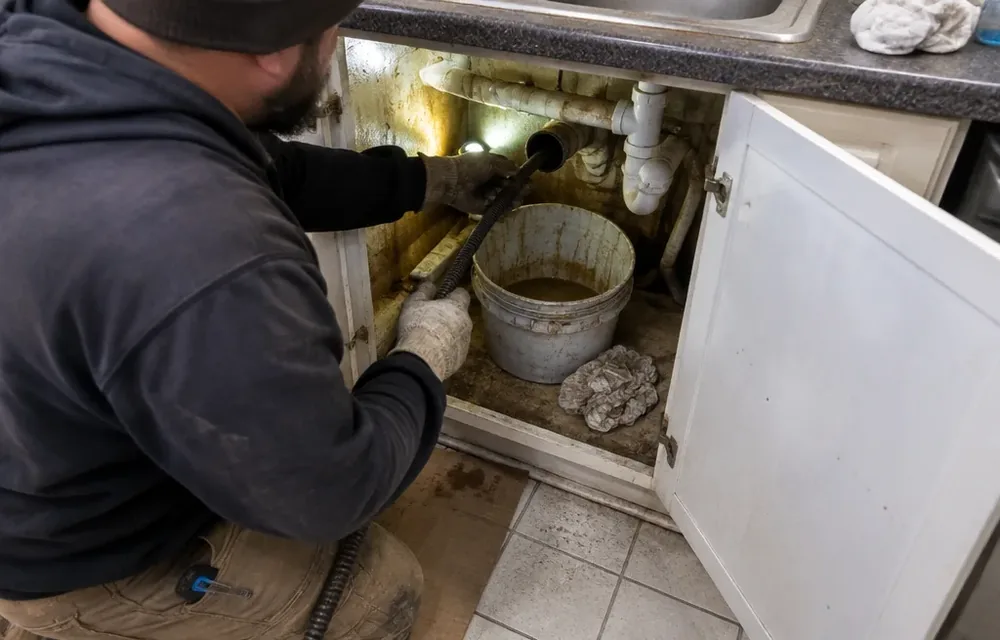
Drain Cleaning
A single slow sink is a nuisance.
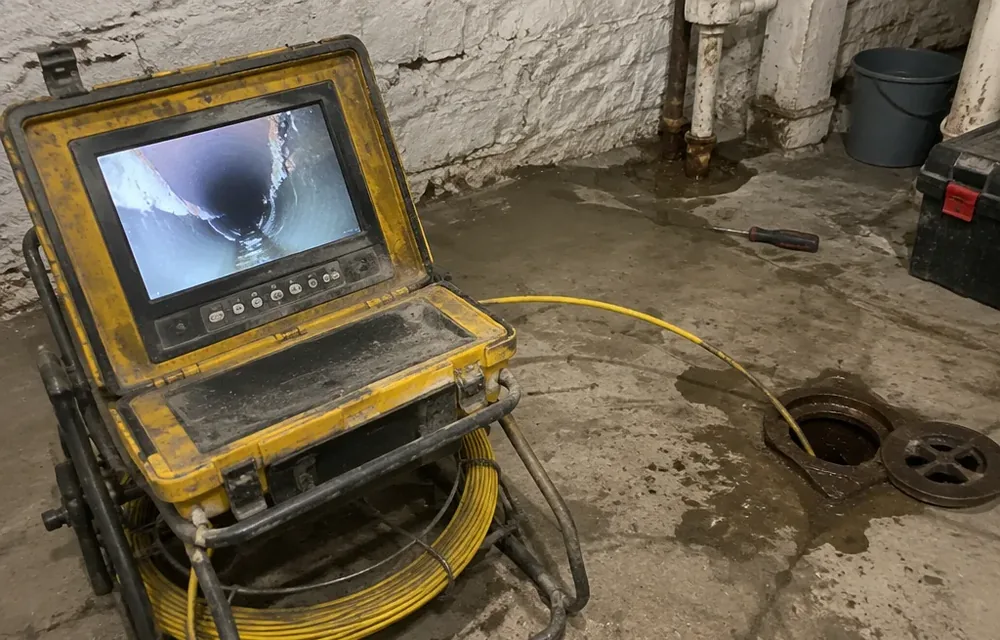
Sewer Camera Inspection
Every expensive sewer decision in Philadelphia — jet, repair, line, replace — depends on one thing: what the pipe actually looks like inside.
Emergency Drain Service
Sewage on the basement floor does not wait for business hours, and neither do we.
Free tools that help with this exact problem
More guides
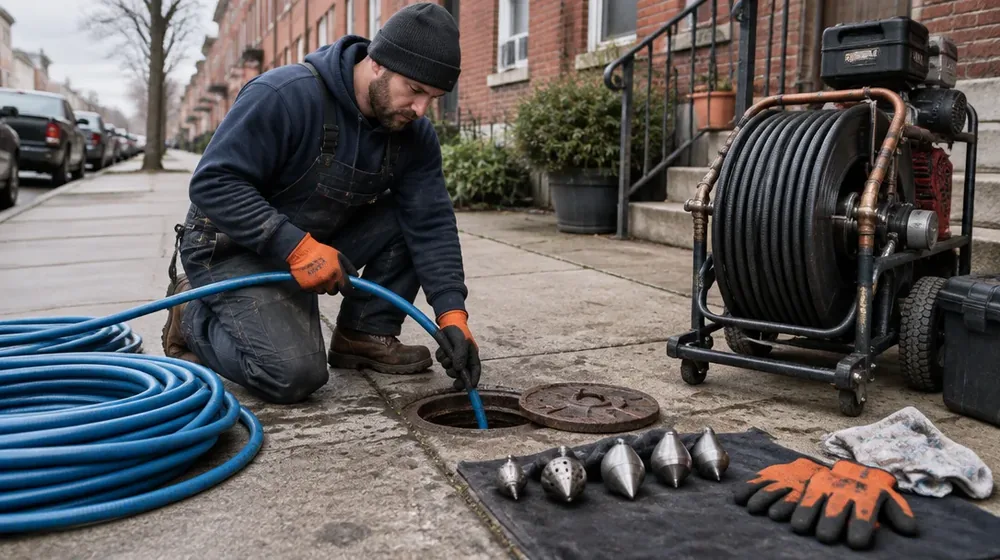
Hydro Jetting vs Snaking: What Philly Homes Need
A cable bores a hole through the blockage so water moves again. A jetter scours the whole pipe wall back toward bare m…

Hydro Jetting Cost in Philadelphia: 2026 Guide
Most Philadelphia homeowners budget around national jetting ranges, then discover access, lateral length, and root cut…
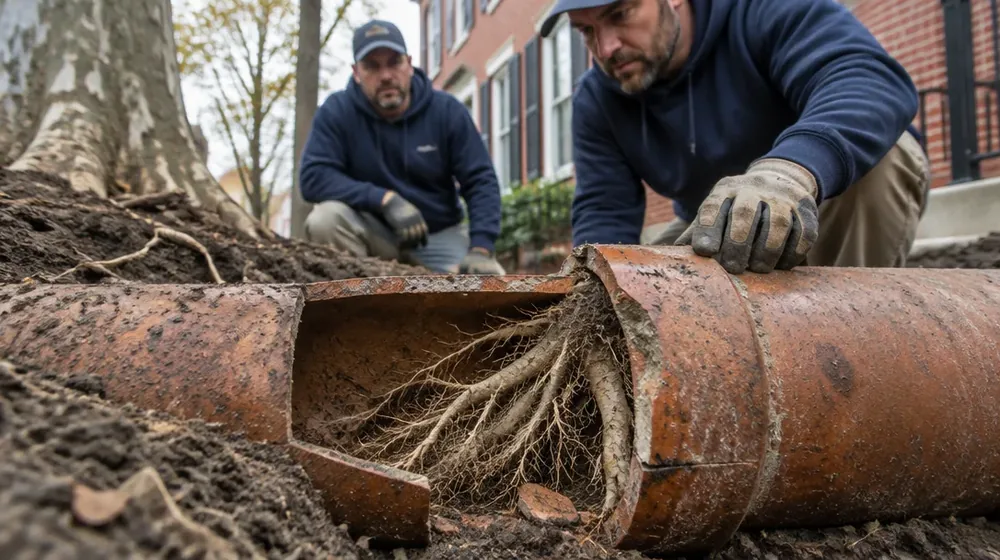
Tree Roots in Philadelphia Sewer Lines Guide
Roots do not break into sound pipe. They find the clay joint that is already leaking, thicken in the flow, and become …
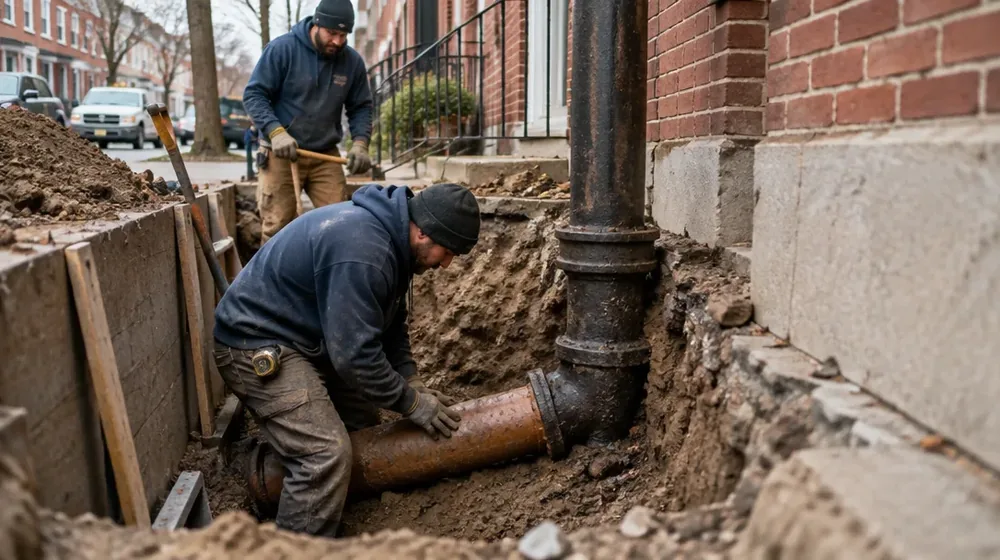
Philly Rowhouse Laterals: Clay, Iron & More
The year your Philadelphia rowhouse was built predicts what is buried in front of it. Clay joints admit roots, cast ir…