Sewer Cleanout in Philadelphia: Find It, Free It, Add One
The sewer cleanout is the capped access riser through which every drain machine, jetter hose, and camera enters your lateral — and in Philadelphia rowhouses it is missing, buried, or seized more often than any other part of the system. Know where yours is before the emergency, because the visit either starts there or gets expensive working around it.
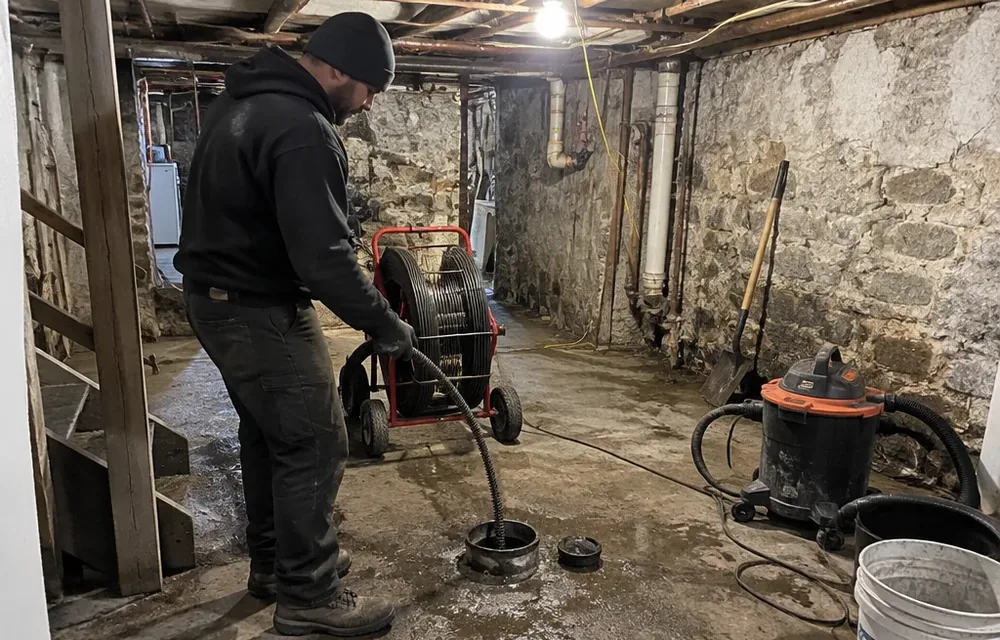
What a sewer cleanout is, and the three kinds Philadelphia has
| Type | Where it sits | What it gives a visit |
|---|---|---|
| Exterior two-way | Yard or areaway between house and street | Straight downhill run to the main plus upstream reach — the ideal launch |
| Basement inline | On the building drain inside the basement | Fast access; flow direction limited, containment matters |
| Sidewalk or curb box | At or past the property line in the footway | Reaches the street-side half utilities and PWD care about |
A cleanout is a vertical riser off the lateral topped with a removable cap — brass, cast iron, or plastic depending on era — whose only job is admitting tools into the pipe without dismantling plumbing. Open the cap and a cable, jetter hose, or camera head feeds directly into flowing diameter; without one, the same work starts by pulling a toilet or going down a roof vent, each slower, messier, and priced accordingly.
The exterior two-way cleanout is the design every Philadelphia rowhouse deserves and few pre-war ones received: a fitting in the yard or areaway with two directions of travel, downhill toward the city main and uphill back toward the house. It converts lateral work from an indoor operation with drop cloths and odor control into an outdoor operation at grade, which is why technicians quote less the moment they see one.
Basement inline cleanouts are the rowhouse reality — a capped tee on the exposed building drain, often against the front foundation wall where the lateral exits toward the street. They work, with containment, but they launch in one direction and put wastewater handling inside finished space. Roof vents are not cleanouts at all, whatever the previous owner believed: feeding cable down a vent risks separating old joints and strands the cutter where no camera can verify it. Sidewalk boxes belong to the boundary zone near the curb and matter most when the defect sits under public ground.
Finding yours in a Philadelphia rowhouse
Start in the basement along the front wall, where the building drain runs exposed toward the street before passing through the foundation. Look for a capped tee or wye pointing up or sideways — brass caps on pre-war iron, plastic on replacements — sometimes painted over so thoroughly the seam hides. Trace the drain from the stack to the wall and check every fitting; the cleanout is on that run by design, and in unfinished basements it is usually visible within minutes.
No basement fitting means going outside along the lateral corridor: out the front, under the areaway or yard, on the line between your front door and the street main. Probe soft ground gently for a buried box or a cap flush with grade, and look for rectangular sidewalk plates or curb-box lids that mark the boundary-zone access. Rear kitchens with long runs to the street sometimes hide an intermediate cleanout under deck boards or rear additions — conversions optimize for rentable space, never for service access.
Finished basements are the great hiders: access panels get drywalled over, closet floors get laid across caps, and storage walls go up in front of tees with no marker left behind. Ask the prior owner point-blank where the cleanout is before closing, and if nobody knows, a camera run with a sonde locate answers it in one visit — the transmitter in the camera head is traced from the surface, marking the lateral path and every accessible point, which doubles as the map for all future work. Photograph whatever you find and keep the photo with the house file.
Stuck, missing, or buried caps
Brass and iron caps seize through decades of corrosion, and the wrong persuasion converts a stuck ten-dollar cap into a cracked riser and an excavation. Soak the threads with penetrating oil and give it a day, use a wrench that fits the cap flats or the recessed square exactly, and work it back and forth rather than committing full force in one direction. An oversized pipe wrench on a thin brass cap deforms the cap into the threads, which is how a service call becomes a replacement.
Know what breaks before you lean on anything. Cast risers crack at the hub when torqued, plastic female adapters split along molded seams, and aged Fernco-style couplings tear if the riser twists inside them. Heat is not the answer on any of this — torching a cap beside old oakum, dried sealant, or gas-adjacent framing trades a stuck cap for a fire call, and caustic products poured to loosen a cap sit in the line as a hazard for whoever eventually opens it. If the cap will not move with correct tools and patience, stop and say so on the service call.
Buried and paved-over access is the Philadelphia specialty: grade changes, repaving, and new patios swallow yard cleanouts a few inches at a time until the map and the ground disagree. A missing cap is worse than a stuck one, because soil, roots, and surface water enter the open riser continuously — if you find an open pipe, cap it the same day even with a temporary cover and schedule the proper fitting. Replacing a cap is trivial money; rebuilding a crushed riser under a new patio is not, which is why every landscaping or paving project should start by marking and raising access to finished grade.
Why every paid visit starts — or stalls — at the cleanout
| Access | What the visit looks like | Effect on the invoice |
|---|---|---|
| Exterior two-way cleanout | Machine stages outside, full run reachable both directions | Fastest visit; camera to the main included routinely |
| Basement cleanout | Contained indoor work with drop cloths and odor control | Standard visit; setup time added |
| Toilet pull, no cleanout | Pull and reset a toilet with a new wax ring for entry | Added labour plus parts on every visit |
| No access at all | Roof vent attempt or exploratory work first | Slowest, riskiest, sometimes refused until access exists |
Access is the first line item on every drain invoice because it sets everything downstream: machine choice, cutter sizing, whether the camera can verify to the main, and how long containment takes. Two identical clogs in identical laterals price differently the moment one house has an exterior two-way and the other needs a toilet pulled — the work inside the pipe is the same, and everything around it is not.
Cameras live or die on access too. A proper cleanout admits the push rod on a straight, stable launch with footage counting from a known zero, which is what makes footage marks transferable between contractors and years. A toilet-pull launch starts the count mid-house with an awkward bend in the first feet, and a vent launch may never reach the defect at all. The kept video file this site insists on is only as good as the entry point it was filmed from.
This is also why technicians talk about cleanouts on visits that have nothing to do with cleanouts. Recommending one after a toilet-pull clearing is not upselling; it is amortizing — a single installed exterior two-way typically pays for itself within two future visits, and every visit after that is faster, cheaper, and better documented. Ask for the installed price in writing while the truck is already there.
Adding the cleanout your rowhouse never got
The standard recommendation is an exterior two-way cleanout on the lateral corridor between the house and the street, set in a traffic-rated box at finished grade where mowers, feet, and frost will not destroy it. Placement follows the camera map: downstream of the house bend, upstream of the suspect joints, clear of utilities that PA One Call marks and clear of the thirstiest street trees where roots will find fresh work fastest.
Expect a half-day excavation with surface restoration matched to what comes up — soil and sod are trivial, brick sidewalk and areaway finishes are not, which is why the figure moves more with surface than with pipe. Work inside your parcel is ordinary plumbing; work approaching or crossing the curb implicates right-of-way rules and Philadelphia Water Department coordination, and any digging anywhere starts with a PA One Call locate ticket plus a private locate for the lateral itself, which 811 does not mark. Confirm permit expectations with the city before scheduling rather than discovering them mid-trench.
Run the payback honestly against your own history. A root-prone clay lateral on a one-to-two-year cutting cycle, or a grease-loaded kitchen lateral on a two-to-three-year jetting cycle, converts every future visit from a toilet pull with parts and setup into a fast outdoor launch — on those rhythms the fitting repays itself quickly and then discounts every visit for the life of the lateral. One-off clogs in sound pipe do not justify it; repeating patterns do, and the camera footage you already paid for is the evidence either way.
What you can safely do at the cleanout yourself
Keep it findable and keep the cap sound: trim plantings back, keep pavers and grade off the lid, photograph its location, and check the cap seats snugly each autumn before freeze-thaw starts working it. A riser that stands an inch proud of settling grade and wears an intact traffic-rated lid will outlast the landscaping around it; one buried under mulch becomes the excavation of next year.
A cautious visual check is legitimate homeowner territory when nothing is actively backing up: ease the cap with the correct wrench, look for standing water near the top of the riser, note any odor stronger than the usual mustiness, and reseat the cap firmly. Standing water visible in an exterior cleanout during dry weather means the lateral downstream is holding water — a belly or restriction worth a camera visit, learned for free.
Never open a cleanout during an active backup. A surcharged lateral holds pressure, and the cap is the only thing between that pressure and the person kneeling over it — sewage under head erupts upward the moment the seal breaks. The same restraint applies to storm surges on combined-sewer blocks: if floor drains are rising, the cleanout stays shut, water use stops, and the call goes out. Curiosity about pipe condition is scheduled as a camera visit; the cap is opened by whoever is equipped for what comes out.
Frequently asked questions
How do I find my sewer cleanout?
Check the basement front wall along the exposed building drain first, then the yard or areaway on the line between your door and the street. Finished basements hide them behind drywall and closets — ask the prior owner, and if nobody knows, a camera run with a surface locate maps the lateral and every access point in one visit.
My house has no cleanout — what now?
Work proceeds by pulling and resetting a toilet, priced with a new wax ring, and the visit should end with a written figure for installing an exterior two-way. On repeating patterns the fitting pays for itself within about two future visits.
Can I open the cleanout cap myself?
For a calm visual check with no backup in progress, yes, with the correct wrench and a prompt reseat. Never open one during an active backup or storm surge — a surcharged lateral is pressurized, and the cap is holding it back.
How much does it cost to install a cleanout?
Typically a few hundred dollars, moving with depth, surface restoration, and right-of-way involvement — sod is trivial, brick sidewalk is not. Digging near the curb adds permits and PWD coordination; every dig starts with a PA One Call ticket.
Does an exterior cleanout really pay for itself?
On any lateral with a repeating interval — roots every year or two, grease every two or three — yes, by converting each future visit from a toilet pull into a fast outdoor launch. One-off clogs in sound pipe do not justify it; the camera footage decides which case you have.
Services mentioned in this guide
Main Sewer Line Cleaning
The lateral is the most expensive drain you own — a 60-to-100-foot clay run from your rowhouse to the street main, shared with stormwater, hunted by street-tree roots.
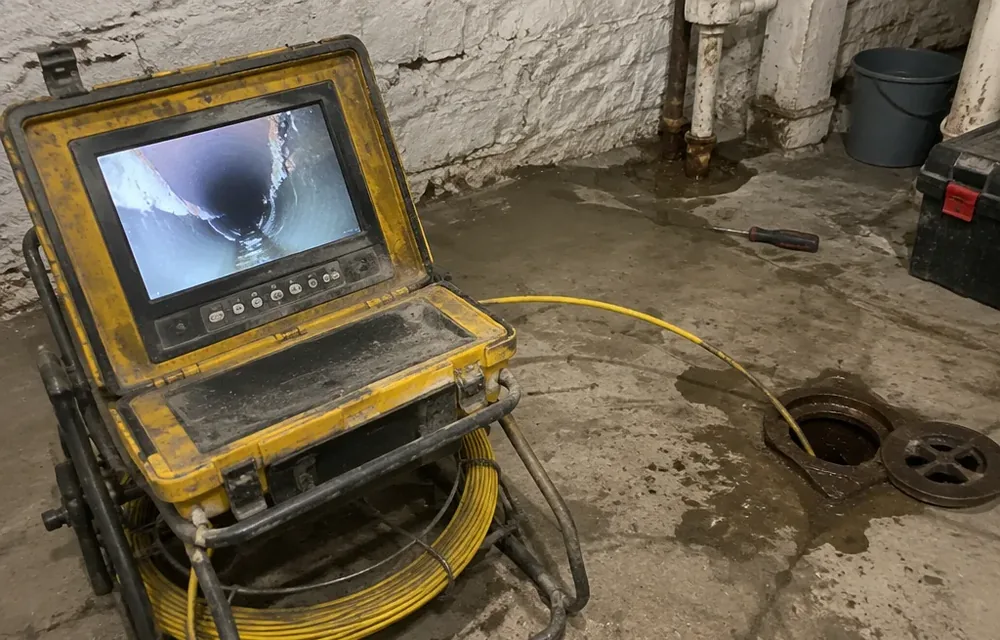
Sewer Camera Inspection
Every expensive sewer decision in Philadelphia — jet, repair, line, replace — depends on one thing: what the pipe actually looks like inside.
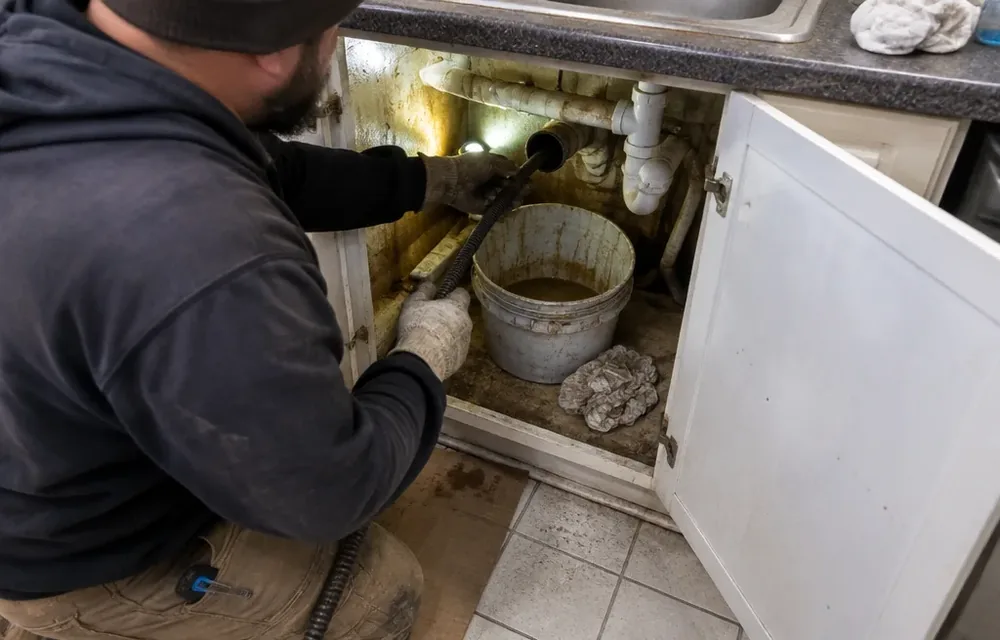
Drain Cleaning
A single slow sink is a nuisance.
Free tools that help with this exact problem
More guides
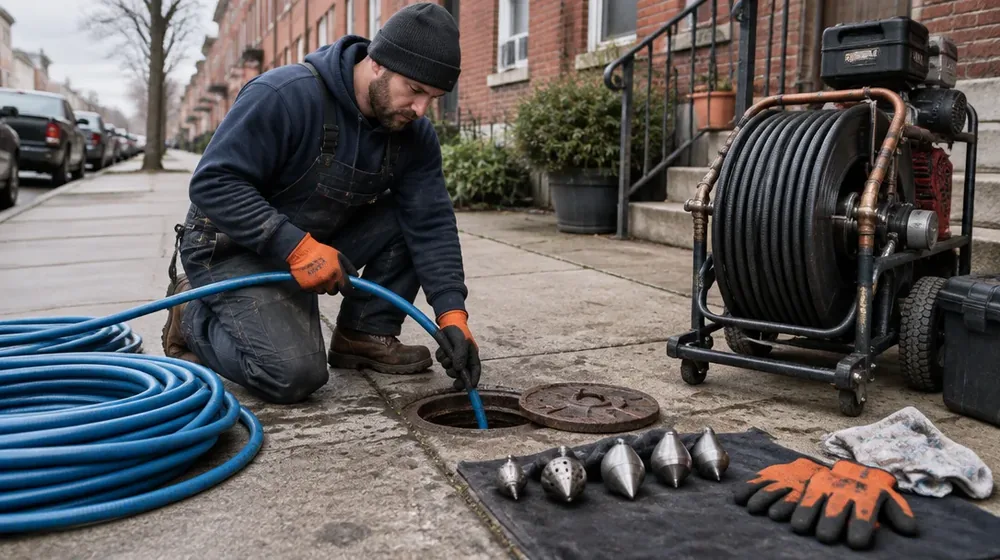
Hydro Jetting vs Snaking: What Philly Homes Need
A cable bores a hole through the blockage so water moves again. A jetter scours the whole pipe wall back toward bare m…

Hydro Jetting Cost in Philadelphia: 2026 Guide
Most Philadelphia homeowners budget around national jetting ranges, then discover access, lateral length, and root cut…
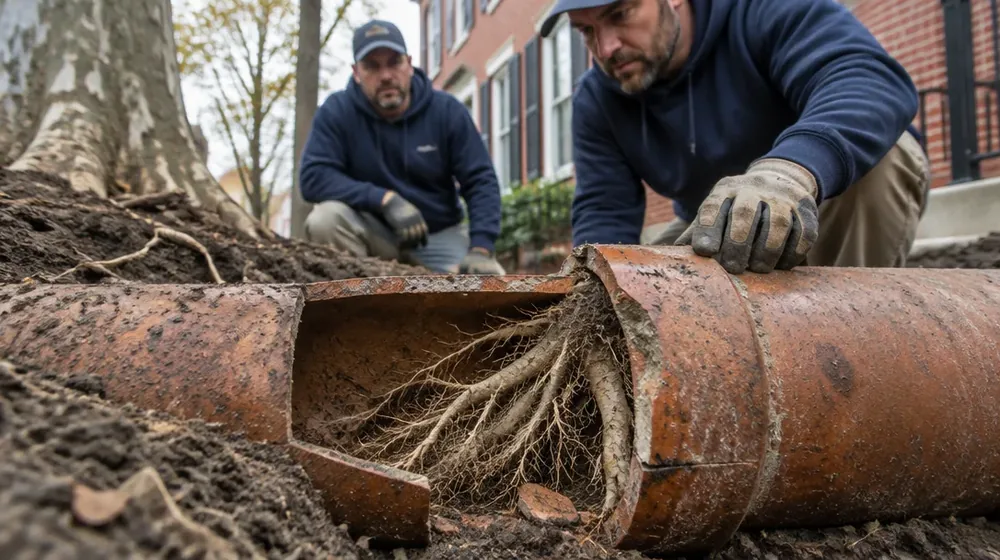
Tree Roots in Philadelphia Sewer Lines Guide
Roots do not break into sound pipe. They find the clay joint that is already leaking, thicken in the flow, and become …
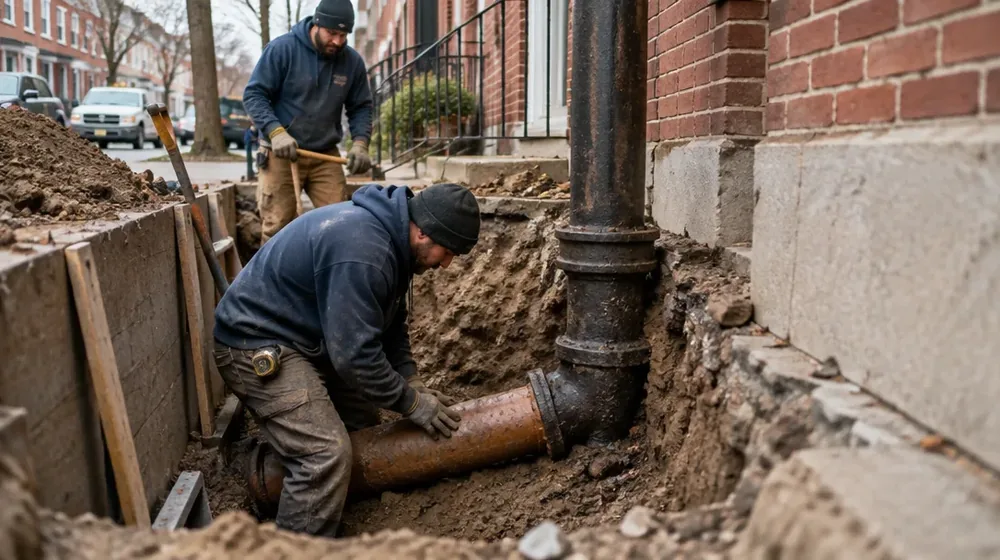
Philly Rowhouse Laterals: Clay, Iron & More
The year your Philadelphia rowhouse was built predicts what is buried in front of it. Clay joints admit roots, cast ir…