About Philadelphia Drain Cleaners
We clear drains, inspect sewers and repair laterals across Philadelphia and its suburbs. The thing we try hardest to be known for is telling people when they do not need what they were about to buy.

Four commitments, and what each one costs us
Diagnose before digging
You are told whether you have a fixture clog or a main-line failure before any tool comes off the truck. Nobody can assess a sewer repair honestly without a camera inspection and a locate first, and we will not open ground without both.
The footage is yours
Every camera inspection produces a video file you keep, with footage marks on each defect and a surface locate with depth — whether or not you hire us for the repair. If you want a competing bid, you have what you need to get one. A contractor who will not give you the file is not protecting you.
We recommend the smallest fix that works
Spot repairs resolve far more sewer problems than the industry tends to lead with. If someone has told you the whole lateral has to come out, we will scope it independently — sometimes that recommendation holds and we say so, and sometimes a full replacement is really a spot repair.
We refuse work that would harm your pipe
We will not hydro-jet Orangeburg, badly corroded cast iron, or cracked clay, because pressure can convert a leak into a collapse. That is a job we turn down several times a month rather than a risk we hand to you.
The problem we are trying to solve
Drain and sewer work is close to the worst case for an informed consumer. The failure is underground and invisible, it happens at the least convenient possible moment, the spread between the cheapest honest answer and the most expensive one is a factor of fifty, and almost nobody calling has any way to evaluate what they are being told.
That asymmetry gets exploited often enough to be a fair default assumption. A homeowner with a slow drain gets sold a lateral replacement; a homeowner with a genuinely failed lateral gets sold a full dig when a spot repair would have held.
So the pages here are written to close some of that gap: what the work involves, what makes a job harder or easier, what should happen before anyone commits to a price, and — repeatedly — the situations where the right answer is that nobody needs to attend at all. The four calculators do the same thing. They run entirely in your browser, ask for nothing, and will sometimes tell you to spend less or nothing.
It is not disinterested — we would like the call. But a customer who understands the job is a better customer, and we would rather have that call than the other kind.
Four things worth insisting on
These apply to any contractor you let into the house, including us.
Check the license and the insurance
Ask for the Pennsylvania contractor registration and look it up on the Pennsylvania Attorney General home-improvement search. It is free, it takes about a minute, and it shows current registration status. Ask for proof of insurance directly as well. Anyone happy to be checked is the only kind worth hiring.
Get the scope in writing before work begins
Parts, labour and what is actually being done, written down and agreed before anyone starts. Confirm the visit charge and any after-hours premium on the call rather than discovering them on the invoice. A price that first appears at the end is a problem regardless of how reasonable the number is.
Insist on a camera before a sewer is priced
Nobody can assess a sewer repair honestly without a camera inspection and a locate. Ask for the video file, the footage marks on each defect and the surface locate with depth, and keep them. That file is what lets you get a competing bid, and it is the single most useful thing you can hold.
Ask what happens if it comes back
Warranty terms, and specifically what is covered if the same line blocks again inside a few months. A recurring blockage usually means the line is coated or defective rather than obstructed, and the second visit is where you find out whether the first one solved anything.
Permits matter too. Sewer repairs and gas appliance work are permitted work in Philadelphia jurisdictions, and unpermitted plumbing reliably resurfaces during a future property sale — resolving it then costs considerably more than doing it correctly now.
Thirty-two Philadelphia-area towns, five areas
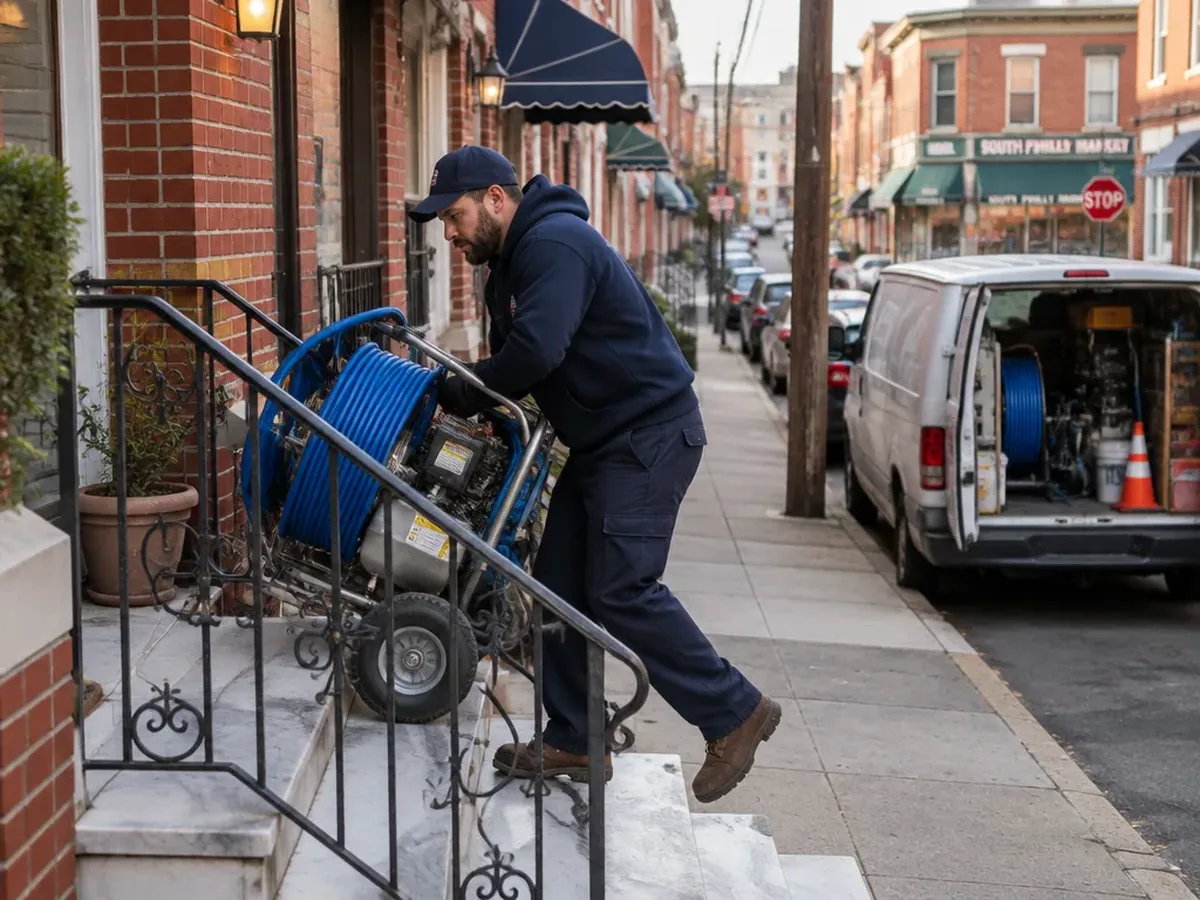
Our service area pages cover the housing stock, likely pipe materials and the specific failure modes that turn up in each city. A South Philadelphia problem and a Main Line problem genuinely have almost nothing in common — combined-sewer rowhouse laterals under brick sidewalks on one side, Wissahickon schist trenching and well-to-sewer conversions on the other.
We work past the 32 cities listed, into the smaller communities around each of them. Response windows are longest in outlying Bucks and Chester county locations, and we give you a realistic one rather than an optimistic one.
There is one form on this site — a callback request — and it asks only for what we need to call you back. There is no account, no signup and no email gate. Nothing you enter into the calculators is stored or transmitted at all. The privacy policy sets out exactly what that means.