What Is Sewer Camera Inspection? Philadelphia Homeowner Guide
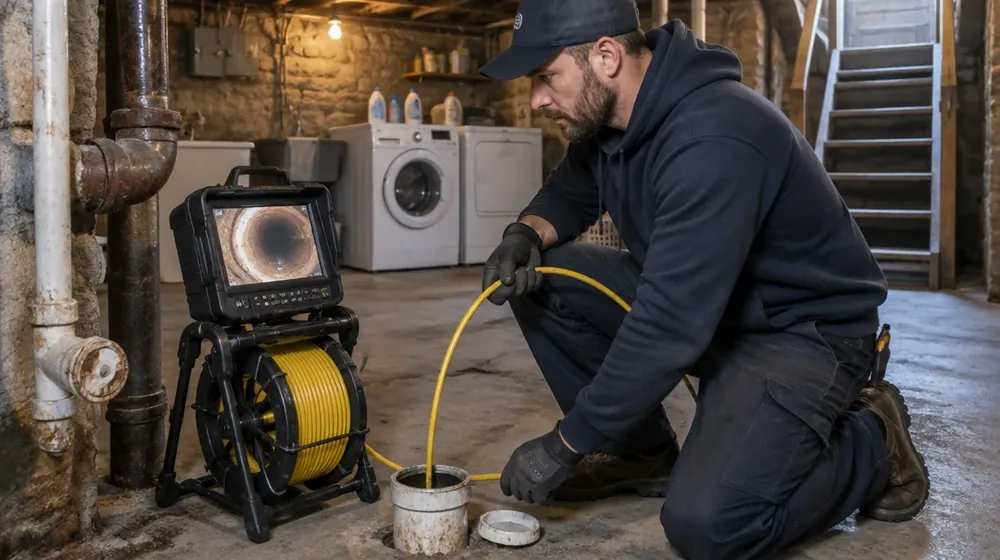
A sewer camera inspection sends a small waterproof camera through a drain or sewer line on a push rod or crawler, recording live video that shows pipe material, breaks, roots, grease, bellies, and exact footage marks to each defect. In Philadelphia it is the standard first step on older rowhouse laterals, repeat backups, and pre-purchase checks because it replaces guessing about buried pipe with measured evidence.
Definition: what a sewer camera inspection actually is
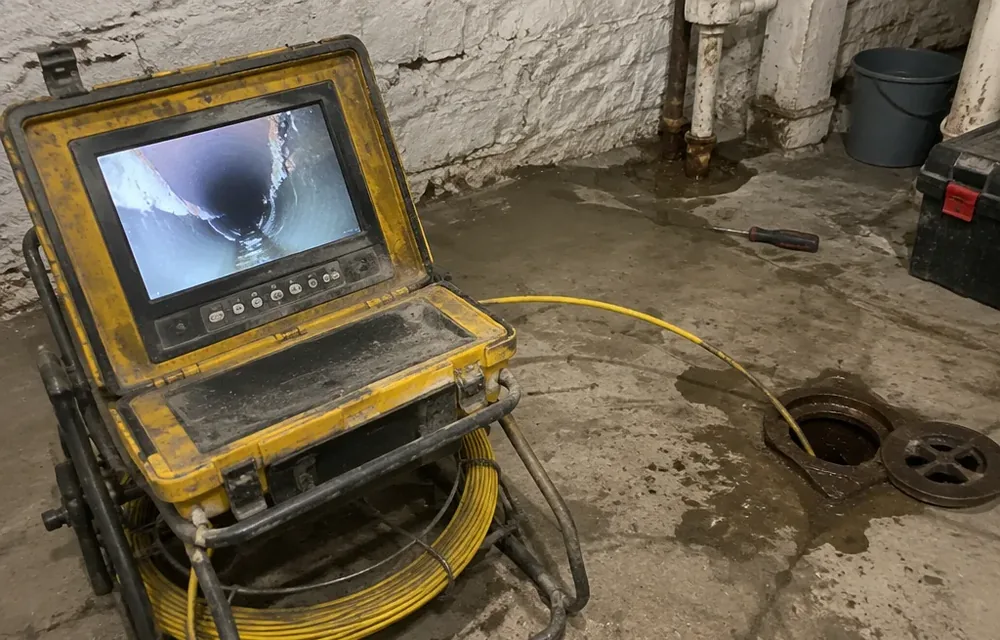
A sewer camera inspection is a visual survey of the inside of a drain or sewer pipe, recorded as video with distance and often depth data. A technician feeds a camera head into the line from an accessible cleanout, sometimes through a pulled fixture when no cleanout exists, and advances it toward the city main or through the branch under study while watching the live feed on a monitor. The recording documents what the pipe is made of, how wide the bore is at each point, where defects sit by footage from the entry, and how water behaves under flow. The deliverable is a video file plus a written log, not a verbal opinion alone.
The value lies in specificity. Without a camera, a slow main lateral could be grease, roots, scale, a belly, a separated joint, or a partial collapse, and each of those points toward a different spend. With a camera, the same symptom becomes a located fact: grease sheets from twelve to thirty-one feet, root entry at forty-two feet under the curb lawn, standing water across a six-foot belly at fifty-five feet, or an offset joint at sixty-eight feet with soil visible. That precision converts every later decision, from cable versus jetter to spot repair versus full replacement, from speculation into scoped work with footage marks any bidder can price.
Philadelphia housing stock raises the stakes of that precision. Brick rowhouses across Fishtown, Kensington, Point Breeze, South Philadelphia, and West Philadelphia often combine cast iron inside the foundation with vitrified clay tile from the wall to the combined main, plus mid-century patches in varied materials including the occasional run of Orangeburg fiber pipe. No two laterals on the same block are guaranteed identical, because each has its own repair history, tree exposure, and trench settlement. Scoping treats the line as an individual with a measurable condition instead of as an address with an assumed layout.
An inspection is also the safety gate for pressurized work. Water under pressure finds every weakness at once, which is ideal on sound pipe and hazardous on failing pipe. A 1915 clay lateral with tight joints accepts scouring well, while the similar-looking lateral next door with separated joints, paper-thin scaled iron, or deformed fiber pipe converts the same pressure into a collapse or a perforation. Nothing visible from the surface distinguishes those two lines. The camera prices the risk in minutes, which is why pre-1970 Philadelphia laterals are scoped before jetting as standard practice rather than as an add-on.
Push cameras versus crawlers: which tool fits which line
| Feature | Push-rod camera | Crawler camera |
|---|---|---|
| How it moves | Technician pushes a stiff rod by hand | Motorized tractor drives itself |
| Best pipe size | Two to six inch house lines | Six inch and larger mains |
| Distance | Up to about two hundred feet on house runs | Longer municipal and commercial runs |
| Bends and branches | Handles tight rowhouse bends well | Needs straighter, larger pipe |
| Cost and setup | Compact reel, faster setup | Larger rig, longer setup |
| Philadelphia use | Rowhouse laterals and branches | Large commercial and shared mains |
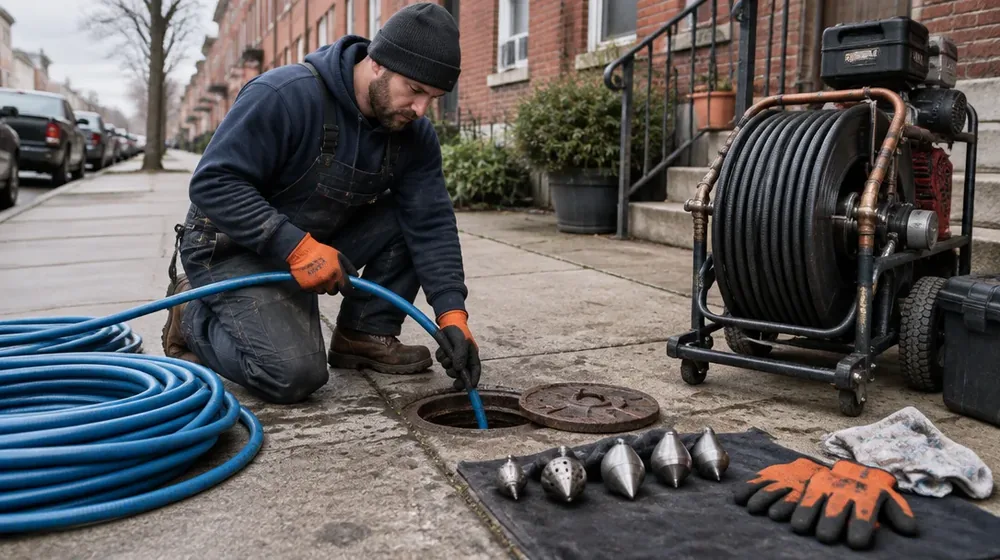
Most Philadelphia home inspections use a push-rod camera, and understanding why prevents confusion when a different tool arrives. A push system coils a semi-rigid rod with a self-leveling camera head inside a portable reel. The technician feeds the rod by hand, feeling bends and offsets through the rod while the head transmits color video with an on-screen footage counter. A built-in sonde, which is a small radio transmitter in the head, lets a surface locator track depth and position from above. For three- and four-inch house laterals with multiple bends through party walls and foundations, that combination of maneuverability, footage accuracy, and locate capability is the right match.
Crawler cameras serve a different scale. A crawler is a motorized tractor with a pan-and-tilt head that drives through large-diameter pipe under joystick control, often with brighter lighting arrays and laser measurement for municipal grading. It excels in straight six-inch and larger mains, long commercial runs, and lines with heavy flow where a push rod would stall. It is oversized for a typical rowhouse lateral, where tight bends and small diameters leave it stranded at the first turn. When a Philadelphia home sits above a large shared main or a commercial property needs a documented survey for capital planning, the crawler earns its mobilization. For a single-family lateral to the curb, the push reel is the proportionate instrument.
Head size, lighting, and centering matter as much as the platform. An undersized head riding low in standing water shows a brown horizon and little else, while a centered head with clean lighting shows the crown, joints, and wall texture that diagnose scale, grease lamination, and fine cracking. Self-leveling heads keep the image upright so a belly reads as water across the bottom rather than as a tilted wall. Competent operators pause at each defect, rotate or pan where the head allows, and narrate footage marks aloud so the recording carries its own index. The difference between a useful survey and a hurried one is rarely the camera brand; it is dwell time at the defects.
Access shapes the tool choice before the reel leaves the truck. An exterior two-way cleanout or a basement cleanout with straight alignment gives the push rod a clean launch and accurate footage zero. A missing cleanout forces entry through a pulled toilet, a vent, or a small test opening, which adds bends that shorten reach and skew footage counts. Many pre-war Philadelphia rowhouses lack a modern cleanout, and installing one is frequently the highest-value money in the whole program: it converts every future inspection and cleaning from an excavation-class visit into a routine one with repeatable footage origins.
What the footage shows, defect by defect
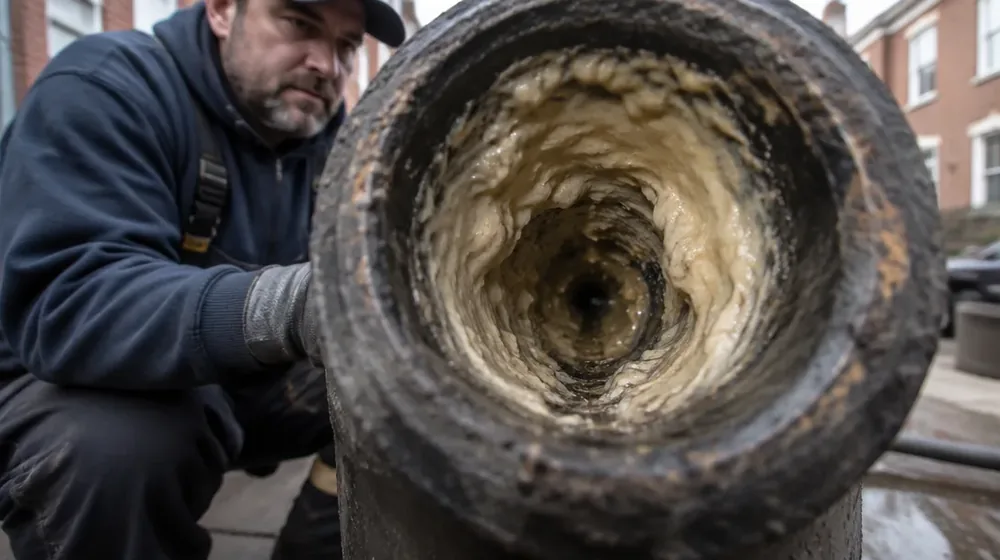
Grease reads as pale, layered sheets that flex under flow and narrow the bore to an off-center opening. On a monitor it looks waxy and laminated, often with darker streaks where water has cut a channel through the deposit. The footage log notes start and end marks plus severity, because a ten-foot grease sleeve near the kitchen stack points to sink habits while a full-length coating to the main points to a line that needs a complete scouring pass. Post-clean footage on the same marks proves the wall returned toward bare material and gives the baseline the next interval is measured against.
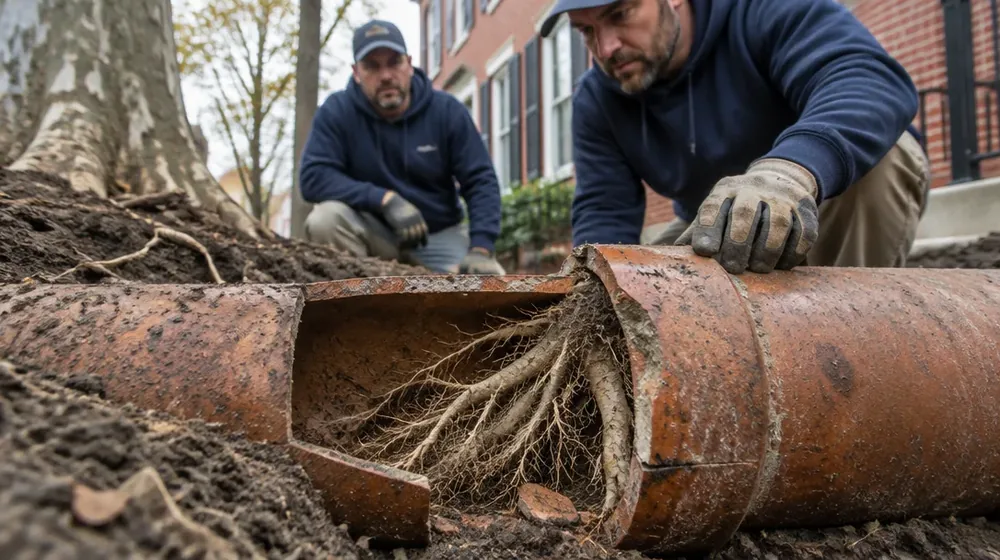
Roots read as white and brown fibers entering at joints, growing denser downstream into a matted mass that traps paper. Early intrusion shows as fine hair waving at a single joint with paper snagging rhythmically as flow passes. Advanced intrusion shows as a solid plug with water ponding upstream and only a thread of flow passing through. Species context helps in Philadelphia, where London plane, silver maple, and honey locust line the curb lawns above clay laterals and exploit every shifted joint. The log records each entry by footage and depth so cutting, flushing, and eventual joint sealing can be priced without re-exploring.
Structural defects each carry a distinct signature that still images alone cannot convey without motion. A belly shows standing water across the bottom with debris drifting back after a flush, proving a sag that cleaning cannot cure. An offset joint shows a lip where one pipe section sits higher than the next, with paper catching on the edge in a repeating rhythm. A crack shows a dark line with infiltration trickling in during wet weather. A collapse shows soil and broken wall with no passage beyond. Orangeburg fiber pipe shows oval deformation, blistering, and delamination like wet cardboard. Scale inside cast iron shows knobby orange growth narrowing the bore with flakes breaking free under flow.
Flow behavior under load is the final observation that separates a survey from a snapshot. A line that looks acceptable at rest can fail under a full tub or laundry discharge, with water rising upstream of a partial obstruction or draining slowly past a belly. Competent inspections therefore include a running-water test while the camera watches, because Philadelphia combined laterals face their real stress during storms and morning laundry peaks rather than during a quiet midday visit. Footage that pairs defect marks with load-test behavior gives the homeowner a forecast, not just a photograph, of how the line will act when demand arrives.
What a locate is, and why footage plus depth matters
A locate translates what the camera sees underground into a marked position on the surface. The camera head carries a sonde that emits a radio signal, and the technician sweeps a handheld receiver across the yard, pavement, or basement slab until the signal peaks. At that point the receiver reports depth to the pipe, and the technician marks the spot with paint or flags alongside the footage reading from the counter. The result is a surface map: root entry at forty-two feet and five feet deep under the curb lawn, belly from fifty-five to sixty-one feet at seven feet deep, city tap at seventy-four feet and eight feet deep beneath the street.
That map controls the price of everything that follows. A spot repair under a brick patio at four feet deep is a different project than the same defect under a public pavement at nine feet deep with traffic control and restoration. A root entry under a curb lawn with a street tree above points to a different plan than the same entry under a rear addition. Without a locate, every bidder prices blind and pads for the unknown. With footage plus depth, bidders price the same defined work, and the homeowner compares methods and value instead of guessing which assumption hides inside each number.
Philadelphia specifics make locates more valuable than in newer suburbs. Party-wall construction, vaulted areaways, stone foundations, and layered pavement over old trench backfill all complicate digging, and combined mains beneath narrow streets add utility congestion that rewards precise marking. The Pennsylvania One Call system, reached at 811, coordinates marking of public utilities before any excavation, while the private lateral locate from the camera sonde marks the drain itself. The two systems together keep a small spot repair small: public lines marked by the utility program, private line marked by the inspection crew, and the excavation opened where both agree.
A locate also creates the record that future work reuses. Keep the video file, the written log with footage and depth pairs, and a simple sketch or photo of the surface marks with a fixed reference such as a stoop corner or a property line. The next service, whether cutting, jetting, lining, or replacement, starts from those marks instead of re-scoping from zero. On a block where rowhouses share similar lateral lengths to the main, that record even helps neighbors understand their own exposure, since root-active joints and settled trenches often repeat along the same curb line with the same tree species above.
Price context and when Philadelphia homes need an inspection
Repeat backups on the same drain
Two or more backups in a year on one line means the pipe is coated or defective rather than merely blocked. Scope before the next cleaning so the money aims at the cause.
Whole-house symptoms
Multiple fixtures slowing together, gurgling across rooms, or water at the lowest drain signals the main lateral. Scope the main to the city tap with a locate.
Pre-purchase diligence
Scope any pre-1970 rowhouse before purchase commitment. A thirty-minute survey can reveal a belly, collapse, or Orangeburg run that changes the negotiation.
Before jetting older pipe
Any lateral of unknown material or pre-1970 age gets scoped first so pressure, flow, and nozzle match the wall the camera proved.
Before lining or replacement
No liner or excavation is priced without measured length, diameter, depth, and defect marks. The survey is the scope document.
After flooding or heavy storm backup
Once water recedes, scope to separate a main surcharge event from a lateral defect that the storm exposed. The distinction decides the next spend.
National price context helps Philadelphia homeowners budget without mistaking context for a commitment. Industry sources commonly place a basic residential camera survey in a low-hundreds band when access is straightforward and the run is short, rising as length, difficulty, locating, and reporting increase. Factors that move a specific visit include cleanout access, lateral length to the main, need for a surface locate with depths, length of the written log, and whether the survey is bundled with cutting or jetting on the same visit. Treat published bands as orientation for planning, and get the scope of the visit in writing before work begins.
Timing matters as much as price. Schedule pre-purchase surveys during the inspection window so findings can inform negotiation rather than arriving after commitment. Schedule repeat-offender surveys before the next cleaning, so the cleaning can be aimed and the footage marks reused. Schedule pre-lining and pre-replacement surveys as the scope document that every bidder shares. After a basement backup during a combined-sewer storm, wait until flow recedes, then scope to learn whether the lateral is defective or simply the lowest opening on a surcharged block. Each of those moments converts the same camera time into a different decision.
Philadelphia Water Department coordination enters the picture when the defect sits near or beyond the curb. House laterals run from the foundation to the city main beneath the street, and responsibility boundaries, pavement opening rules, and restoration standards follow local code and department practice. A survey with footage to the tap and depths at the curb gives any discussion with the department or with bidders a shared factual base: where the lateral meets the main, how deep it sits, and what condition each segment is in. The Philadelphia Plumbing Code and the Pennsylvania Uniform Construction Code presume work appropriate to the pipe and location at hand, and measured footage is how appropriateness is shown.
Keep the deliverable and it keeps paying. Store the video file, the log with footage and depth pairs, and the surface-mark sketch where a future technician can find them. A 2026 survey that logs grease from twelve to thirty-one feet and a root entry at forty-two feet lets a 2028 visit cut, flush, and verify in one trip instead of two. On rowhouse blocks where lines share age, material, and tree exposure, that file also shortens every later conversation, because the pipe stops being a mystery and becomes a measured asset with a known length, depth, and defect list.
Frequently asked questions
What is a sewer camera inspection?
It is a video survey of the inside of a drain or sewer pipe. A camera head travels through the line from a cleanout while recording material, defects, footage marks, and flow behavior. The result is a video file plus a written log that later cleaning or repair work can be priced from.
What is the difference between a push camera and a crawler?
A push camera rides on a hand-fed rod and suits two- to six-inch house lines with bends. A crawler is a motorized tractor for six-inch and larger straight mains and long commercial runs. Most Philadelphia rowhouse laterals are surveyed with a push system.
What does a locate add to the inspection?
A locate marks the surface position and depth above each defect using a signal from the camera head. Footage tells how far along the line a defect sits, while depth tells how deep the dig or repair would go. Together they let bidders price the same defined work.
How much does a sewer camera inspection cost?
Use national bands for orientation: a straightforward residential survey often sits in the low hundreds, rising with length, access difficulty, locating, and reporting. Philadelphia factors include cleanout access, lateral length to the combined main, and whether locating with depths is included. Confirm scope in writing.
When should a Philadelphia homeowner schedule one?
Before buying a pre-1970 rowhouse, after two backups on the same line within a year, whenever whole-house symptoms point to the main, before jetting older or unknown pipe, and before any lining or replacement is priced. After storm backups, scope once flow recedes.
Services mentioned in this guide
Sewer Camera Inspection
Every expensive sewer decision in Philadelphia — jet, repair, line, replace — depends on one thing: what the pipe actually looks like inside.
Main Sewer Line Cleaning
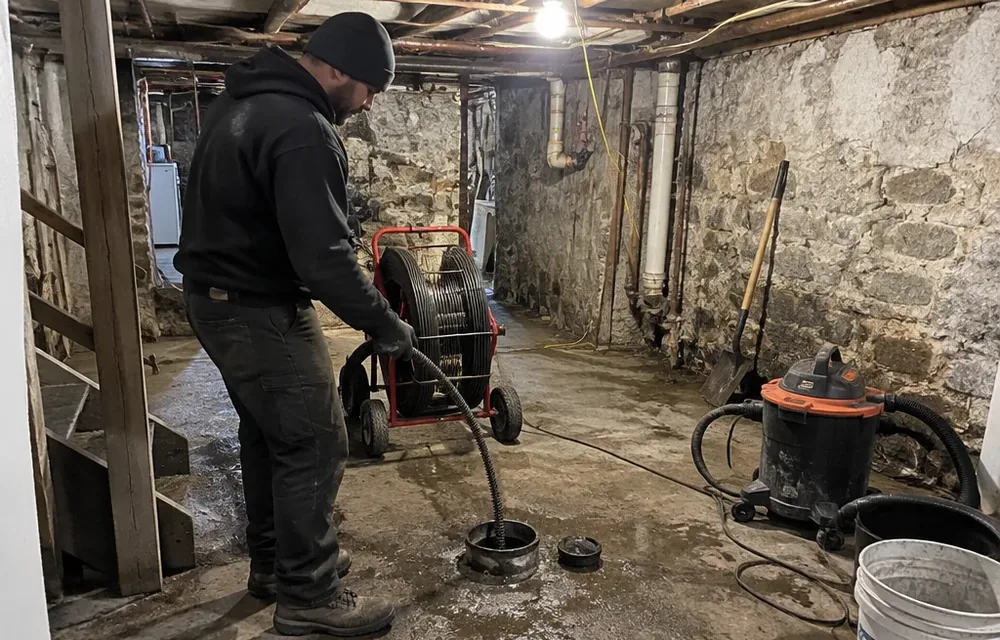
The lateral is the most expensive drain you own — a 60-to-100-foot clay run from your rowhouse to the street main, shared with stormwater, hunted by street-tree roots.
Hydro Jetting
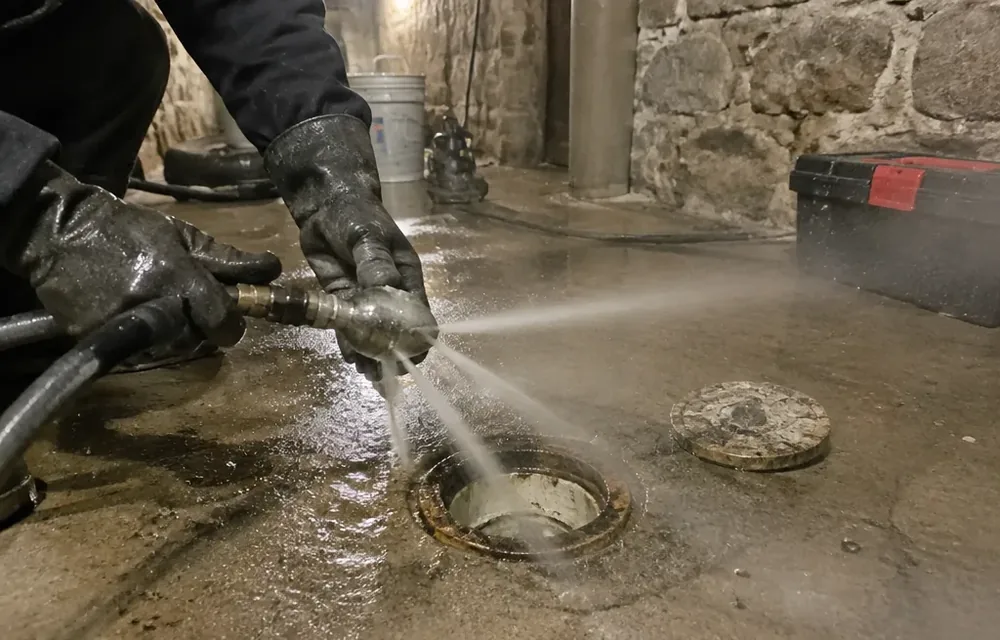
A cable bores a hole through the clog.
Free tools that help with this exact problem
More guides
Hydro Jetting vs Snaking: What Philly Homes Need
A cable bores a hole through the blockage so water moves again. A jetter scours the whole pipe wall back toward bare m…

Hydro Jetting Cost in Philadelphia: 2026 Guide
Most Philadelphia homeowners budget around national jetting ranges, then discover access, lateral length, and root cut…
Tree Roots in Philadelphia Sewer Lines Guide
Roots do not break into sound pipe. They find the clay joint that is already leaking, thicken in the flow, and become …
Grease Lines: Philly Rowhouses & Restaurants
Grease goes down warm and liquid, meets cold iron, and becomes a wall coating rather than a plug. That is why the same…