What Is Hydro Jetting? A Plain-English Guide for Philadelphia Homes
Hydro jetting is a drain cleaning method that uses high-pressure water, sent through a hose and a specially drilled nozzle, to scour the inside wall of a pipe back toward bare material and flush the loosened debris out to a cleanout. In Philadelphia it is used most often on grease-coated kitchen laterals, sludge-filled main lines, and root-active clay joints where a cable opens a channel but leaves the coating behind.
The plain-English answer: what hydro jetting is
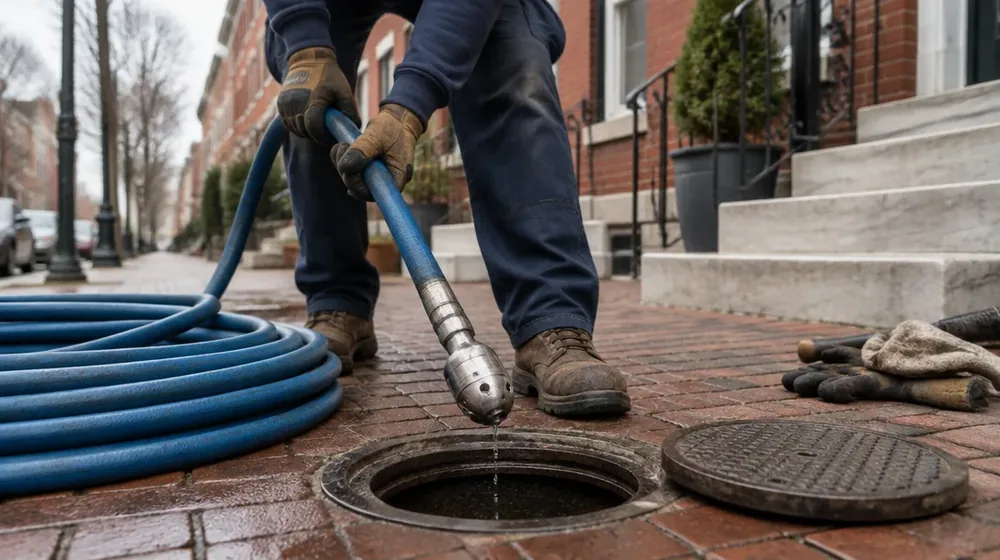
Hydro jetting is pressurized water cleaning for the inside of drain and sewer pipes. A pump at the truck or on a compact cart pressurizes ordinary water, a flexible hose carries that water into the line from a cleanout, and a small steel nozzle at the end of the hose turns the flow into focused jets that cut through the blockage ahead and scour the wall around the full circumference on the way back out. If you need one sentence to remember, it is this: hydro jetting uses high-pressure water jets that spray backward to pull the hose forward while scrubbing the full pipe wall, then flushes grease, sludge, roots, and scale out to the cleanout so flow is restored to near-original diameter.
That sentence is worth memorizing because it separates jetting from every other drain method in one pass. A plunger moves water and air to shift a soft plug near a fixture. A cable bores a narrow channel through an obstruction so water can pass. Enzymes and bacteria digest organic film slowly over days. Jetting is the only common residential method that cleans the full circumference of the wall and transports the debris out of the system in the same visit, which is why its results last longer on coated lines even though the visit takes more setup.
For Philadelphia beginners the rowhouse context makes the definition concrete. Many brick rowhouses from Fishtown and Kensington to Point Breeze, South Philadelphia, and West Philadelphia carry original or mid-century laterals in cast iron and clay that have collected decades of cooking fat, soap, biofilm, and fine grit. A cable punches a path through that layered coating like a straw through soft butter, and water flows again for a while. Jetting peels the layers off the wall itself, so the pipe bore returns closer to the diameter it had when first installed, and the next load of debris has far less to cling to.
One more distinction matters before any other detail. Hydro jetting is cleaning, not repair. It removes material that does not belong inside the pipe, including grease, sludge, paper, root hair, soap, and loose scale. It does not close an open clay joint, regrade a sagged belly, thicken iron wall that corrosion has already thinned, or reshape fiber pipe that has gone oval. A sound pipe comes out of jetting cleaner and more measurable. A failed pipe comes out of jetting cleaner and still failed, which is useful knowledge because it points the next dollar toward repair instead of another cleaning.
The equipment: pump, hose, nozzle, and cleanout
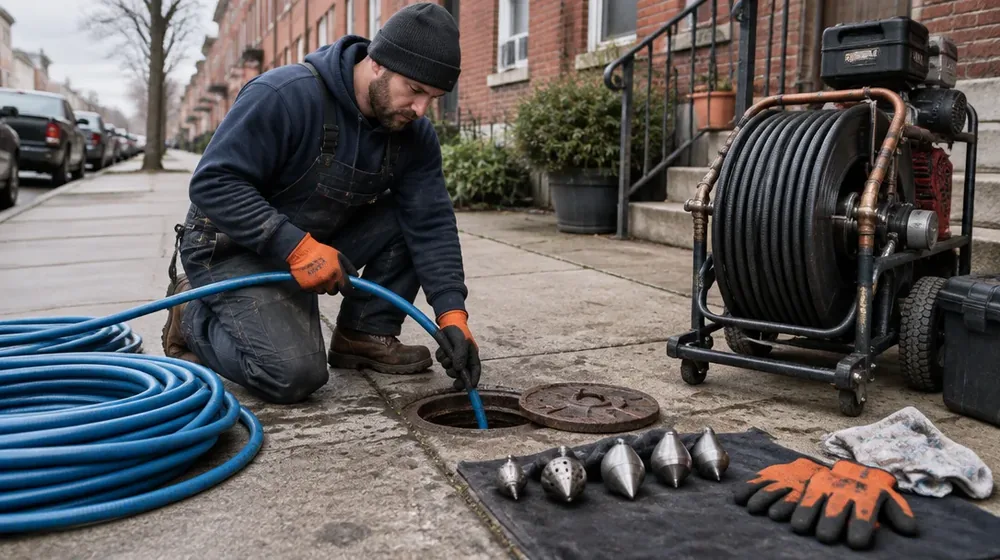
A jetting system has four working parts plus the access point that makes them usable. The pump builds pressure and sustains flow, the hose delivers water into the line and withstands abrasion against iron and clay, the nozzle shapes the water into cutting and scouring jets, and the water itself does the cutting, scrubbing, and carrying. The cleanout is the doorway, usually an exterior two-way fitting or a basement fitting with a removable cap, through which hose and camera enter and debris exits. Without a proper cleanout the same work must be improvised through a pulled fixture or a vent, which is slower, messier, and harder to control.
Pumps for house laterals are commonly rated in bands rather than single numbers, because pressure and flow are paired to the pipe at hand. A four-inch Philadelphia house lateral is often worked in a middle band of pressure with high single-digit to mid-teen gallons per minute of flow, so the jets have enough energy to peel grease while the return flow keeps debris suspended until it reaches the cleanout. Small two-inch kitchen and bath branches use smaller hoses and gentler settings. Six-inch mains and commercial lines use larger hoses and higher sustained flow. The pairing is the skill, since high pressure with weak flow can cut without carrying, and high flow with the wrong nozzle can wash without scouring.
Nozzles are the interchangeable tools at the end of the hose, and each shape does a different job. A penetrator head concentrates forward jets to drill through a fully blocked section so a cleaning head can follow. A rotary or spinning head sweeps jets around the full circumference to peel grease sheets and biofilm evenly off the wall. A root head pairs mechanical cutting edges with flushing jets for street-tree root masses that water alone cannot shear. Cornering heads navigate the tight bends of old rowhouse plumbing where rigid heads hang up. A truck that carries only one general head is equipped for one kind of line, and Philadelphia laterals are never one kind of line.
Support gear completes the setup and explains why a proper visit involves more than a hose. A camera reel and monitor document material, diameter, footage marks to each defect, and depth at the curb before pressure is committed. A foot pedal or dump valve gives the operator instant pressure control. Gloves, eye protection, splash containment, and a wet vacuum manage the return flow at the cleanout. Traffic cones and hose ramps protect the run from truck to areaway on narrow rowhouse blocks with parked cars tight to the curb. When all of it arrives together, the job is being treated as a system, not as a single blast of water.
What comes out of a Philadelphia pipe during jetting
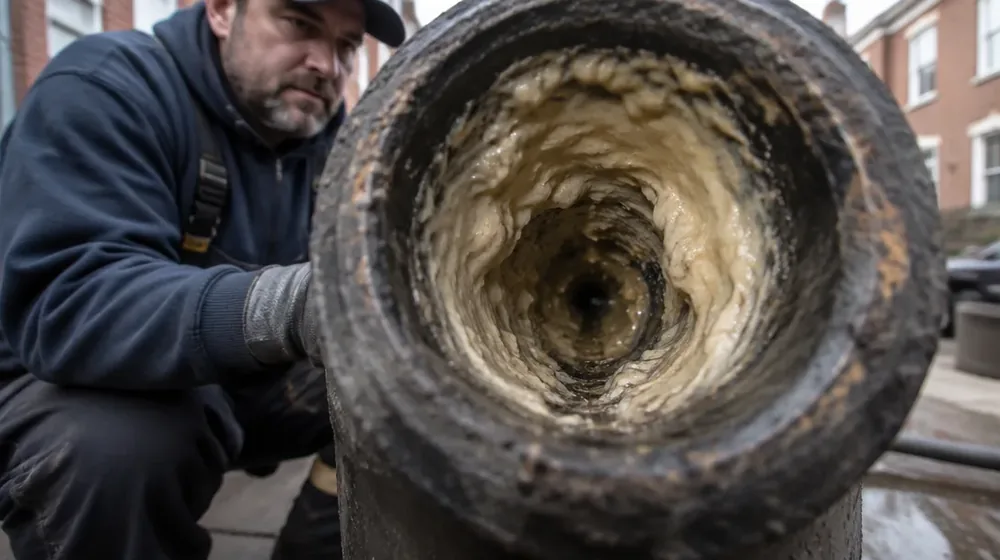
Grease is the most common discharge from rowhouse kitchen laterals, and it is unmistakable on site. It exits as pale tan and gray sheets, soft ribbons, and emulsified slurry that smell strongly of cooking fat and dish soap. South Philadelphia blocks with shared party-wall kitchen runs, plus the restaurant corridors of Center City, South Street, and East Passyunk, lay down layer upon layer of congealed fat that dishwashers discharge with cooler water, which congeals faster inside cast iron. On camera before the work the bore looks narrowed to a small off-center opening. After a proper scouring pass the wall reads dark and round again, with joints visible and water running clear under load.
Sludge and biofilm are the second discharge, common in main laterals connected to combined sewers. Philadelphia operates largely on combined sewers where sanitary flow and stormwater share the same mains, so grit, street wash, paper, and organic solids settle inside house laterals during dry spells and shift during storms. Jetting lifts that settled bed, breaks up the paper matrix, and carries the load out to the cleanout in a dark, silty flow that gradually clears. Homes with wet-weather backups often show this pattern: a line that drains acceptably in dry weather because the settled bed still passes flow, then backs up when a summer cloudburst off the Schuylkill or Delaware corridor surcharges the main and the narrowed lateral becomes the first to fail.
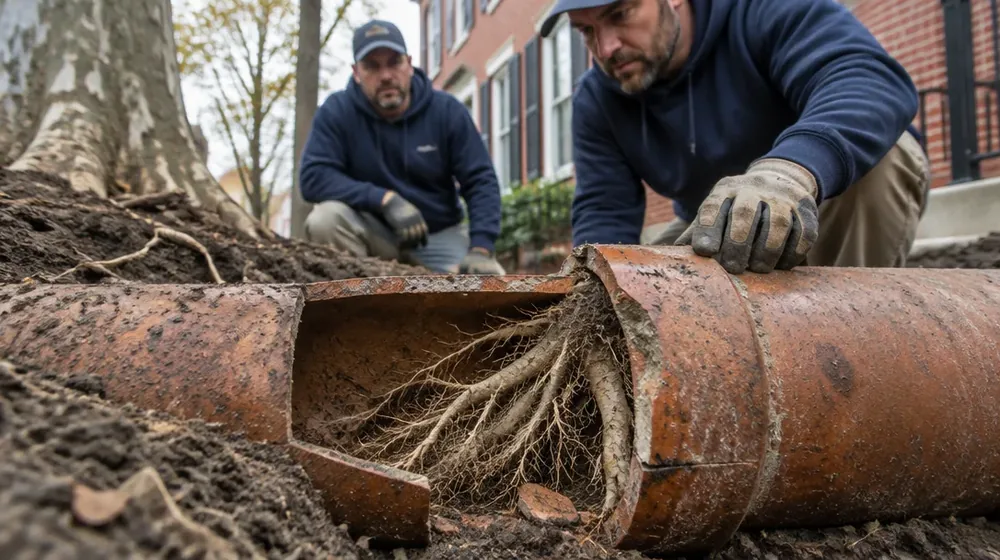
Root hair and trapped paper form the third discharge on clay laterals near mature street trees. London plane, silver maple, and honey locust roots enter through shifted clay joints from the curb lawn to the foundation, then trap paper and solids into a fibrous mass. Jetting after mechanical cutting flushes fine hair and pulp out in stringy clumps, and the return flow carries a surprising volume of paper that had been snagged upstream of the root ball. The open joint itself remains after the flush, which is why the material removed is only half the story and the footage log of entry points and depths is the other half.
Scale, soap, and grit round out what exits older iron and branch lines. Cast iron sheds orange and black tuberculation flakes as knobby rust growth loosens under the jets. Bathroom branches release gray soap curds bound with hair and biofilm. Areaway and French-drain tie-ins release sand and leaf grit washed in from rear yards and light wells. Each material tells the operator something about interval and habit: grease points to sink discipline, sludge points to combined-system settling and storm exposure, roots point to joint condition and tree proximity, and scale points to iron age and remaining wall thickness that the post-clean camera pass must confirm.
What hydro jetting cannot fix
| Condition | What jetting does | What still needs repair |
|---|---|---|
| Grease-coated sound pipe | Scours wall toward bare material, restores bore | Changed sink habits so coating does not rebuild |
| Root hair in clay joints | Shears hair and flushes trapped paper | Joint sealing or spot repair that closes the entry |
| Loose iron scale | Strips loose flakes and exposes wall | Descaling or replacement where wall is thin |
| Sagged belly holding water | Washes sediment out temporarily | Regrade or replace the low section |
| Collapsed or separated joint | Clears debris around the failure | Excavation or lining that rebuilds structure |
| Orangeburg fiber pipe | Not applied; pressure deforms the wall | Replacement with modern pipe material |
The table draws the boundary that protects Philadelphia homeowners from spending cleaning money on repair problems. A belly, meaning a sagged section that holds standing water, is the clearest example. The jets wash sediment out of the low spot, yet the low spot remains, and solids settle there again within months. Camera footage showing water sitting mid-line with debris drifting back after a flush is the signature, common where old trench backfill settled beneath rowhouses or where delivery traffic compacted soil over the lateral. Cleaning a belly on a quarterly schedule banks money away from the regrade that would end the cycle.
Open joints, cracks, and collapses set a second boundary. Jetting shears fine root hair and flushes the sludge that roots trap, which extends the interval between services on a clay lateral with a known root entry, but it does not close the joint that admitted the roots. A separated clay joint with a void above it can even collapse when supporting sludge washes out, which is one reason pre-1970 laterals are scoped before pressure is applied. Collapsed sections, offset joints with soil visible through the gap, and Orangeburg fiber conduit that has gone oval or blistered are repair targets, and the honest sequence pairs the cleaning with a repair plan so maintenance can be compared against correction on paper.
Wall loss is the third boundary and the least visible from the surface. Cast iron loses thickness as tuberculation consumes the wall from the inside, and aggressive scouring on paper-thin iron can expose pinholes or perforate the stack. That outcome is not operator error when the camera warned of thin wall; it is the pipe reaching the end of its service life under a cleaning that finally revealed it. The Pennsylvania Uniform Construction Code and the Philadelphia Plumbing Code presume work appropriate to the pipe at hand, and declining to pressurize a failing line is diligence. Post-clean footage showing pitting, pinholes, or daylight through the wall has done its diagnostic job even though cleaning cannot do a structural one.
Where jetting fits in a Philadelphia rowhouse
Rowhouse kitchens are the clearest residential fit. A century of cooking fat down a three- or four-inch cast iron lateral, compounded by garbage disposals and cool-water dishwasher discharge, builds a laminated coating that no cable removes. When the same kitchen sink slows every few months, the cable returns coated in black grease, and neighboring homes of the same era along blocks from Girard Avenue to Oregon Avenue report the same rhythm, the run is coated along its length. A scouring pass from a proper cleanout, paired with fat, oil, and grease discipline at the sink afterward, resets the clock for a long interval on sound pipe. For a full overview of methods, timing, and preparation, see the hydro jetting service page that anchors this guide.
Main laterals with street-tree exposure are the second fit, handled as a sequence rather than a single tool. Roots from curb-lawn maples and planes exploit every shifted clay joint, and the competent order is to cut the mass to full diameter, jet the hair and trapped solids out so they do not re-lodge downstream, and log the cleared line on camera with footage marks and depths. Either tool alone leaves half the job undone: cutting without flushing leaves hair to mat again, and flushing without cutting leaves the mass to regrow from the same joint. The logged footage then prices the eventual joint sealing or spot repair that closes the entry for good.
Commercial kitchen lines, basement floor drains tied to combined laterals, and pre-lining preparation are the remaining fits that Philadelphia serves up regularly. Restaurant floor drains and grease interceptors downstream of fryers load pipe at a pace no home kitchen matches, which is why they sit on calendar schedules rather than symptom schedules. Basement floor drains in low-lying blocks near the rivers back up first during storms because they are the lowest opening on a combined lateral, and a full-bore cleaning before storm season gives them maximum diameter when the main surcharges. Trenchless lining crews require a scoured, measured host pipe before any liner goes in, so jetting plus descaling plus camera verification is the standard prep that lets a liner bond and hold grade.
Bathroom branches near the fixture are the clearest non-fit, and naming them prevents overspending. Hair bound with soap within a few feet of a trap is a fixture blockage that a hand auger or small drum machine clears completely, because there is no long coated run to scour. Running a jetter into a one-and-one-half-inch branch with old slip joints risks driving water past connections for no added benefit. The exception is a whole-house cast iron stack in a three-story rowhouse with decades of internal scale, where controlled descaling under camera supervision earns its keep. Matching tool to distance, diameter, and coating is the judgment that keeps jetting targeted instead of routine.
What a proper visit looks like, step by step
Confirm branch versus main
One slow sink points to a branch run. Multiple fixtures, gurgling across rooms, or water at the lowest drain points to the main lateral. The distinction decides which hose diameter, nozzle set, and access point the crew prepares.
Work from a real cleanout
An exterior two-way fitting or a basement fitting with room to work, opened carefully and from the side in case the line is charged. Homes without a cleanout often gain one before jetting, which converts every future service into a routine visit.
Scope older or repeat lines first
Material, diameter, footage to each defect, and depth at the curb and at repair candidates. On pre-1970 Philadelphia laterals this pass decides whether jetting is safe and which band of pressure and flow applies.
Open, scour, then flush
A penetrator head opens fully blocked footage, a spinning head scours the wall on a slow retrieval pass with steady dwell time, and a flushing pass carries debris out to the cleanout instead of resettling it downstream.
Verify on camera and under load
Post-clean footage proving bare wall and round bore, with footage marks logged for the record, followed by a full tub or laundry discharge that proves the line carries a real slug of water without hesitation.
Leave footage plus a maintenance note
Video file with marks, the grease extent or root entries logged by footage and depth, and a written note on interval versus repair so the next visit starts informed instead of re-exploring.
Measure any visit against that sequence and most weak outcomes become visible early. A visit that moves straight to pressure with no camera on a 1915 lateral skips the step that protects fragile pipe. A visit that declares success without running water under load skips the proof that matters in a storm. A visit that leaves no footage asks the homeowner to pay for a result nobody documented. The full sequence takes more time on site and saves far more across the life of the line, because each later decision starts from measured evidence instead of memory.
Preparation and aftercare are simple but consequential. Clear access to the cleanout, hold laundry and dishwashing while the line is open, keep children and pets clear of hoses under tension, and plan for the camera monitor review at the end so the footage marks make sense before the crew leaves. Afterward, seat exterior caps firmly before a hard freeze, restore sink discipline so grease goes to the trash, and keep the video file where a future bidder can use it for pricing without re-scoping. Philadelphia freeze cycles punish lines left wet and open in January, and combined-system storm season punishes lines left narrowed in June, so timing the thorough cleaning ahead of both windows carries the line through with full diameter available.
Frequently asked questions
What is hydro jetting in simple terms?
It is high-pressure water cleaning for the inside of pipes. A pump pressurizes water, a hose carries it into the line from a cleanout, and a nozzle turns it into jets that cut blockages and scrub the wall around its full circumference while flushing debris out. It cleans the wall itself, not just a channel through the plug.
Is hydro jetting the same as power washing a drain?
The principle overlaps but the tools and stakes differ. A jetter uses drain-rated hoses, pressure and flow matched to pipe diameter and material, plus nozzles that pull the hose forward and scour evenly. It also works inside buried laterals under camera control, where a surface washer would damage pipe and leave debris behind.
Will hydro jetting damage old Philadelphia pipes?
It can damage pipe that is already failing, which is why older laterals are scoped first. Sound cast iron, clay, and plastic handle appropriate settings well, while Orangeburg fiber pipe, paper-thin scaled iron, and separated joints do not. A proper operator matches pressure, flow, and nozzle to the footage rather than running one setting for every house.
What comes out during a jetting visit?
Most often grease sheets and slurry from kitchen lines, dark sludge and paper from combined laterals, root hair and pulp from clay joints near street trees, plus soap, biofilm, and iron scale from older branches. The discharge appearance helps set the maintenance interval and points to habit changes that keep the wall cleaner longer.
When is jetting the wrong answer?
When the pipe itself has failed. Bellies that hold standing water, collapsed or separated joints, Orangeburg that has gone oval, and iron with wall loss need regrading, repair, or replacement rather than another scouring. Jetting still helps by cleaning and documenting those lines, but it cannot rebuild structure.
Services mentioned in this guide
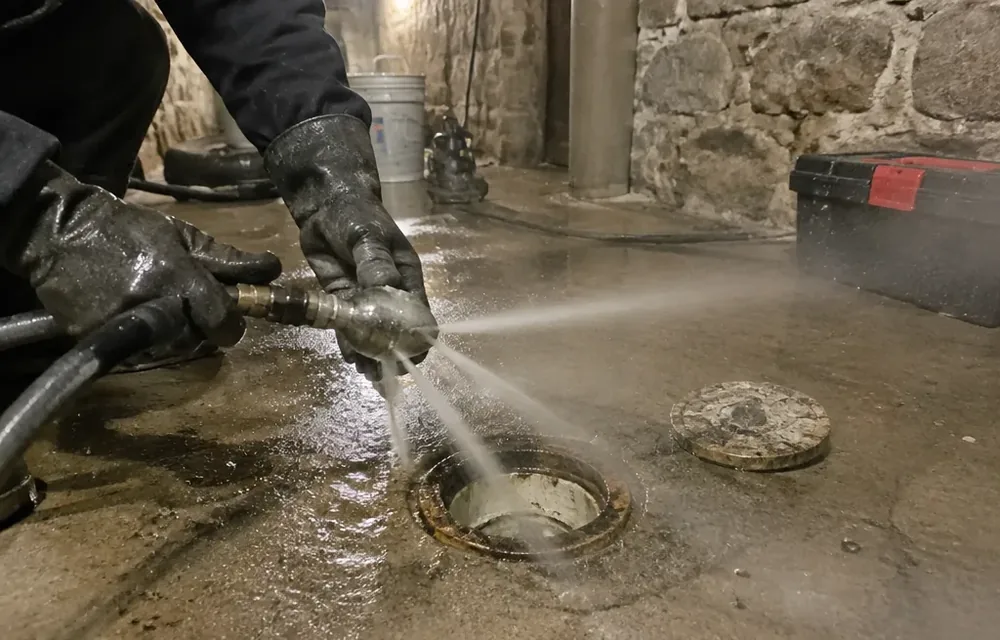
Hydro Jetting
A cable bores a hole through the clog.
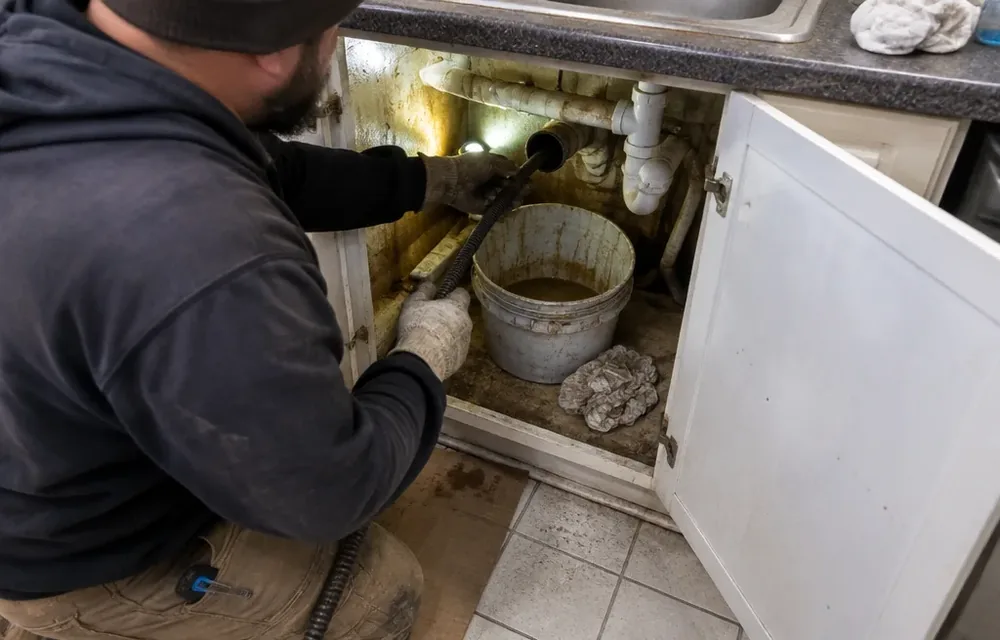
Drain Cleaning
A single slow sink is a nuisance.
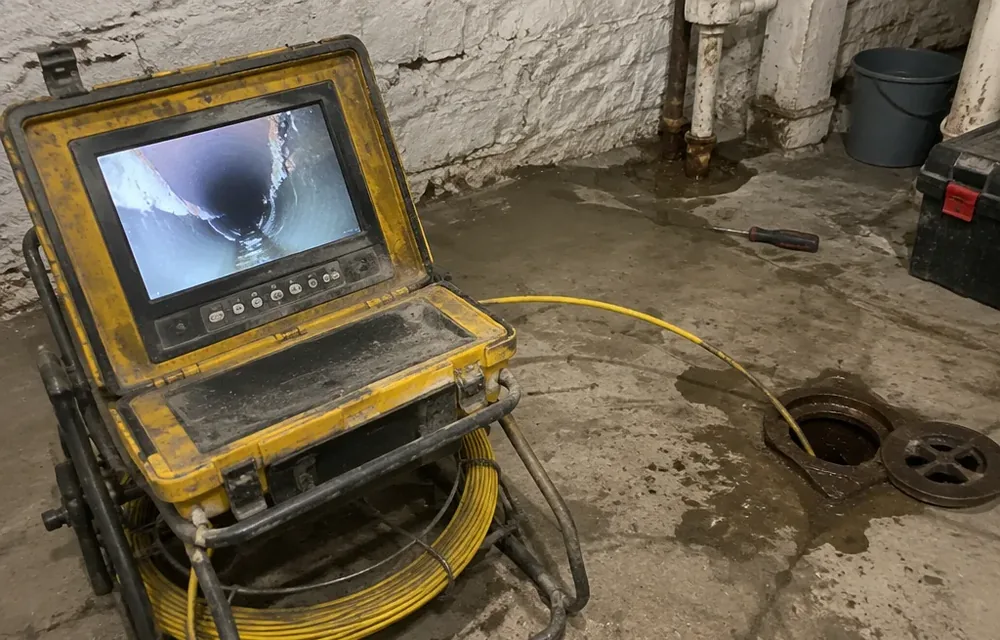
Sewer Camera Inspection
Every expensive sewer decision in Philadelphia — jet, repair, line, replace — depends on one thing: what the pipe actually looks like inside.
Free tools that help with this exact problem
More guides
Hydro Jetting vs Snaking: What Philly Homes Need
A cable bores a hole through the blockage so water moves again. A jetter scours the whole pipe wall back toward bare m…

Hydro Jetting Cost in Philadelphia: 2026 Guide
Most Philadelphia homeowners budget around national jetting ranges, then discover access, lateral length, and root cut…
Tree Roots in Philadelphia Sewer Lines Guide
Roots do not break into sound pipe. They find the clay joint that is already leaking, thicken in the flow, and become …
Grease Lines: Philly Rowhouses & Restaurants
Grease goes down warm and liquid, meets cold iron, and becomes a wall coating rather than a plug. That is why the same…